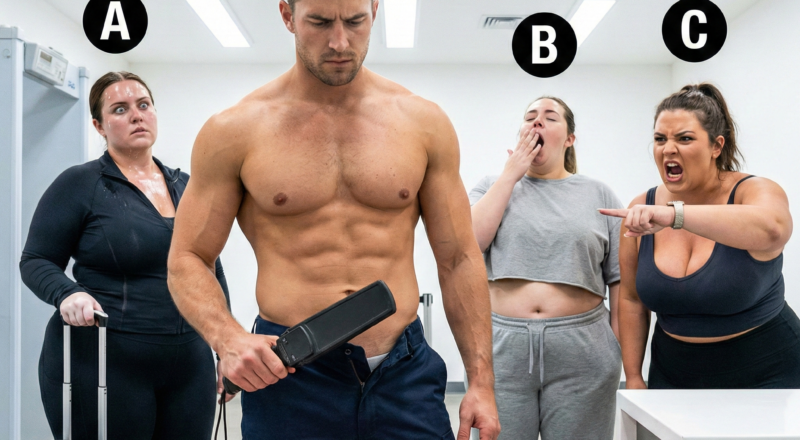
In the high-stakes world of international border security and customs enforcement, the primary objective is to detect “Malicious Intent” amidst a sea of innocent travelers. Whether the asset in question is undeclared currency, intellectual property, or contraband, the psychological “tells” of concealment remain consistent. A person carrying a secret is under immense cognitive load. Their brain is fighting to suppress the truth while their body is involuntarily leaking signs of stress.
In this viral psychology test, we present a security checkpoint scenario. Three subjects are undergoing screening. Two are compliant; one is concealing a high-value asset. The objective is to identify the “Security Risk” (The Smuggler) by auditing their non-verbal communication and physiological responses.
Phase 1: The Decoy Analysis (The “Visual Noise”)
Upon entering the visual field, your attention was likely immediately hijacked by the Neon Pink Object on the conveyor belt. In security training protocols, this is known as a “Distractor.” It is a high-salience item that draws the eye but poses no threat.
The Psychology of Misdirection:
Why is it there? It tests your “Selective Attention.” In a complex environment like an airport or a trading floor, noise is constant. A skilled observer knows that the loudest object is rarely the most dangerous. The smuggler relies on the chaos of the environment to slip through unnoticed. If you focused on the neon object, you allowed a visual anomaly to distract you from the behavioral anomaly occurring right next to it.
Phase 2: The Behavioral Audit
Analyzing Suspect B: The “Low-Risk Traveler”
Let’s audit the subject in the center (labeled B). She is yawning and looking at the ceiling. Her body language is loose and open.
Physiological State: She is displaying “Parasympathetic Dominance.” In simple terms, she is relaxed. A person who is hiding contraband is in a state of high alert; they cannot yawn or relax because their adrenaline is spiking. Boredom is the ultimate sign of innocence in a security setting. She has nothing to fear, so her body is conserving energy.
Analyzing Suspect C: The “Compliance Friction”
Now, look at the subject on the right (labeled C). She is pointing at her watch and yelling at the security personnel.
Risk Assessment: This behavior is classified as “Entitlement” or “Aggression,” but rarely “Guilt.” People who are smuggling high-value assets try to be invisible. They want to blend in. They do not draw attention to themselves by causing a scene. While Suspect C is annoying, her willingness to engage in conflict proves she is not afraid of scrutiny. She is inviting attention, which a smuggler would never do.
Analyzing Suspect A: The “High-Risk Concealer”
Finally, we examine the subject on the left (labeled A). She is standing perfectly still, staring straight ahead.
1. The White-Knuckle Grip: Look at her hand on the luggage handle. Her knuckles are white from the pressure. This is “Resource Guarding.” The brain subconsciously commands the hand to hold onto the valuable or illicit item tightly. She is terrified of being separated from the bag because it contains the evidence.
2. The Autonomic Response (Sweat): Notice the perspiration on her forehead. Even in a climate-controlled environment, fear triggers the sweat glands. This is a biological response that cannot be faked or suppressed. It is the body preparing for “Flight.”
3. The Frozen Stare: She is refusing to look at the guard or the other passengers. This is “Gaze Avoidance.” She believes that if she makes eye contact, her guilt will be seen.
The Verdict: Suspect A is Hiding Something. Her body is screaming what her mouth is refusing to say.
Phase 3: Legal Implications of Asset Nondisclosure
Why is spotting the smuggler so critical? Beyond physical security, asset nondisclosure has massive financial and legal ramifications.
1. Civil Asset Forfeiture
In many jurisdictions, failure to declare assets (such as cash over $10,000 or luxury goods) results in immediate “Civil Asset Forfeiture.” The government seizes the asset, and the burden of proof shifts to the traveler to get it back. This is a common risk for high-net-worth individuals moving capital across borders without proper legal counsel.
2. Customs Fraud and Liability
Attempting to bypass customs duties is a federal offense. The penalties often include fines up to 300% of the item’s value, plus potential incarceration. For a business, getting caught smuggling inventory can lead to the revocation of import/export licenses, effectively destroying the supply chain.
3. Insurance Voidance
If a traveler is smuggling high-value jewelry or art and it is lost or seized, their insurance policy is automatically void. Insurance contracts require “Lawful Conduct.” Committing a crime during the transport of the asset nullifies the coverage, leaving the owner with a total loss.
Phase 4: The Psychology of “Duping Delight” vs. Fear
While some skilled liars experience “Duping Delight” (the thrill of fooling someone), most first-time smugglers experience “Leakage.”
Leakage is defined as the unintentional betrayal of inner feelings through non-verbal channels. Suspect A is leaking fear. Her brain is calculating the probability of getting caught, the cost of the fine, and the shame of arrest. This cognitive load makes her rigid and unresponsive. She is not reacting to the delay (like Suspect B) or the annoyance (like Suspect C) because her entire mental bandwidth is consumed by the secret.
Conclusion: The Body Doesn’t Lie
Words can be scripted, but sweat cannot. The innocent are bored or angry. The guilty are terrified. If you spotted the white knuckles and the sweat, you have the eyes of a federal agent.
Scroll back up to the image. Ignore the yelling. Watch the hands. The tightest grip holds the darkest secret.
