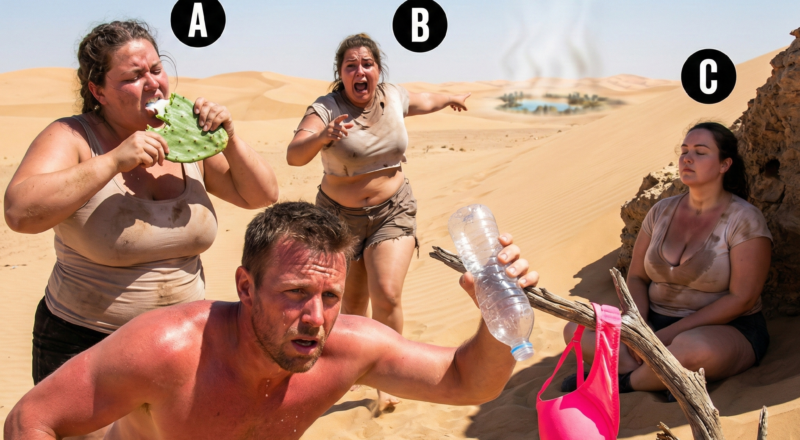
In the field of emergency management and actuarial science, survival is not a matter of luck; it is a matter of “Caloric Math.” When a system (whether a corporation or a human body) enters a crisis state with limited resources, the strategy must shift immediately from “Growth” to “Preservation.” The entities that fail are usually the ones that expend capital on high-risk, low-reward activities. The entities that survive are the ones that minimize their “Burn Rate.”
In this viral psychology test, we present a life-or-death scenario in a desert environment. Three subjects are facing extreme heat and dehydration. Two are accelerating their demise; one is extending their timeline. The objective is to identify the “Survivor” by auditing their physiological discipline.
Phase 1: The Decoy Analysis (The “Cognitive Heatstroke”)
Upon entering the visual field, your attention was likely immediately hijacked by the Neon Pink Object on the dead branch. In psychological stress testing, this is known as an “Incongruent Stimulus.”
The Psychology of Distraction:
Why is it there? It tests your “Focus Under Pressure.” In extreme heat, the brain begins to hallucinate or fixate on weird details. A survivor filters out the noise to focus on the essentials: Water, Shade, and Rescue. If you focused on the neon object, you are wasting mental energy on a variable that does not contribute to your survival probability.
Phase 2: The Behavioral Audit
Analyzing Suspect A: The “Toxic Asset”
Let’s audit the subject on the left (labeled A). She is attempting to drink fluid from a cactus.
The Survival Myth: This is one of the most dangerous myths in survival lore. Most cactus species contain toxic alkaloids in their sap.
The Physiological Cost: Consuming this sap induces severe vomiting and diarrhea. In a dehydration scenario, this is catastrophic. It accelerates fluid loss. In financial terms, this is equivalent to taking out a high-interest payday loan to pay off a credit card. It provides momentary relief but creates a massive long-term liability that bankrupts the system.
Analyzing Suspect B: The “Panic Expenditure”
Now, look at the subject in the center (labeled B). She is running and screaming, pointing at the horizon.
The Panic Loop: She is likely chasing a mirage or simply succumbing to hysteria.
The Burn Rate: Physical exertion in extreme heat increases the body’s water loss by up to 300%. Screaming expels moisture from the lungs. She is “Spending” her water reserves at a rapid rate with zero return on investment. She represents the panic seller in a stock market crash—reacting emotionally and locking in losses.
Analyzing Suspect C: The “Conservative Strategist”
Finally, we examine the subject on the right (labeled C). She is sitting perfectly still in the shade. Her eyes are closed. She is not moving.
1. Metabolic Braking: By remaining motionless, she lowers her heart rate and body temperature. This minimizes sweat production. She is hoarding her resources.
2. Nasal Breathing: By keeping her mouth closed, she retains the moisture that would be lost through panting.
The Verdict: Suspect C will Survive. She understands that in a crisis where resources cannot be generated (no water), the only winning move is to reduce consumption to near zero. She is buying time for rescue to find her.
Phase 3: The Business of Risk Management
Why is this test relevant to the modern economy? Because the principles of desert survival are identical to corporate restructuring and wealth preservation.
1. Liquidity Crises
When a company runs out of cash (water), the CEO cannot afford to launch expensive new marketing campaigns (running) or invest in unproven, risky products (eating cactus). The only viable strategy is “Austerity.” You must cut costs, freeze hiring, and sit still until the market turns. Suspect C is the prudent CEO navigating a recession.
2. Insurance and Liability
In the life insurance industry, actuaries calculate premiums based on risk behaviors. A person who engages in high-risk activities (like Suspect A and B) pays higher premiums because their “Probability of Claim” is higher. A person who demonstrates caution and preservation (Suspect C) is a preferred risk. Understanding these behaviors is key to understanding how value is assessed in the insurance market.
3. Emergency Funds
The water in your body is your “Emergency Fund.” Suspect B blows her fund in one hour of panic. Suspect C rations her fund over three days. Financial literacy, like survival skills, is fundamentally about impulse control. The ability to delay gratification (or reaction) is the strongest predictor of long-term solvency.
Phase 4: The Psychology of “Do Nothing”
In a culture that rewards action, doing nothing is often the hardest thing to do.
Action Bias: Humans have a bias toward action. We feel better if we are *doing* something, even if that something is harmful (like drinking poison cactus). Suspect C has overcome this bias. She has the mental fortitude to choose logical inaction over emotional action. This “Stoic Discipline” is rare, but it is the defining trait of survivors.
Conclusion: The Art of Stillness
Panic is expensive. Calm is profitable. The person running is dying. The person sitting is living. If you spotted the woman conserving her energy, you understand the true cost of survival.
Scroll back up to the image. Ignore the running. Look at the breathing. Stillness saves lives.
