In the study of social psychology and crisis management, heroism is defined not by how one looks, but by what one risks. Modern society, driven by social media, has created a phenomenon known as “Performative Allyship” or “Virtue Signaling.” This occurs when an individual feigns concern for a cause or a crisis to gain “Social Capital,” rather than to provide actual aid. Distinguishing between the person looking for a solution and the person looking for a photo op is critical in emergency response and charitable giving.
In this viral psychology test, we present a disaster scene. Three subjects are reacting to the event. One is providing aid; two are extracting value. The objective is to identify the “True Altruist” (The Hero) by auditing their physical state and locus of attention.
Phase 1: The Decoy Analysis (The “Vanity Trap”)
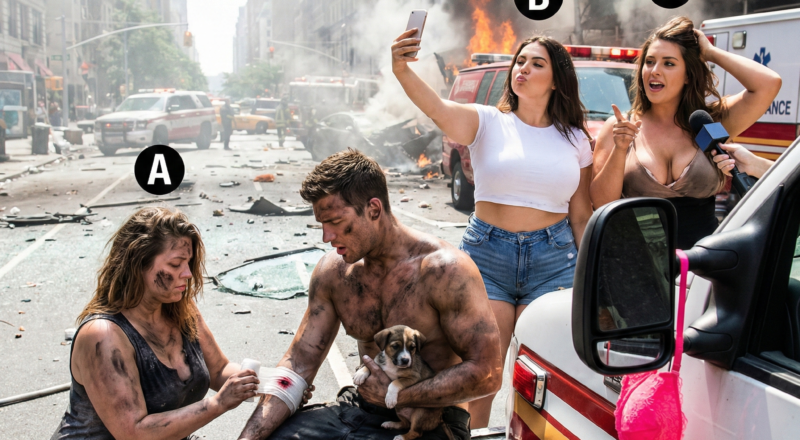
Upon entering the visual field, your attention was likely immediately hijacked by the Neon Pink Object on the ambulance. In cognitive filtering, this is an “Irrelevant Stimulus.”
The Psychology of Noise:
Why is it there? It tests your “Triage Logic.” In a disaster, there is always debris and confusion. A first responder must ignore the oddities to focus on the casualties. If you stared at the neon object, you allowed visual noise to distract you from the human suffering occurring inches away.
Phase 2: The Altruism Audit
Analyzing Suspect B: The “Virtue Signaler”
Let’s audit the subject in the center (labeled B). She is taking a selfie with the disaster.
The Motivation: This is “Narcissistic Supply.” She is using the suffering of others as a prop to enhance her own digital image. While she may post a hashtag about “prayers,” her action (taking the photo) benefits only herself. This behavior is common in the age of digital media, where *appearing* to care is often rewarded more than *actually* caring.
Analyzing Suspect C: The “Opportunist”
Now, look at the subject on the right (labeled C). She is talking to the news crew.
The Motivation: This is “Narrative Control.” She is positioning herself as the spokesperson for the tragedy. While communication is important, in the immediate aftermath of a crisis, the priority is stabilization. The person seeking the microphone is usually the one who watched from the sidelines. She wants the credit without the risk.
Analyzing Suspect A: The “Silent Actor”
Finally, we examine the subject on the left (labeled A). She is covered in soot. Her dress is torn. She is kneeling in the dirt, bandaging a wound.
1. The Evidence of Risk: The soot on her skin is the physical proof that she entered the danger zone. You cannot save someone from a fire without smelling like smoke.
2. The Action Bias: She is not talking. She is not posing. She is doing. Heroism is a verb. It requires physical intervention.
The Verdict: Suspect A is the Real Hero. She risked her safety and her appearance to preserve life.
Phase 3: The Psychology of ” The Bystander Effect”
Why do most people act like Suspect B or C? It is often due to the “Bystander Effect”—the diffusion of responsibility. People assume someone else will help, so they retreat into the role of observer or commentator.
The Heroic Exception: Suspect A has broken the Bystander Effect. She accepted personal responsibility for the outcome. This trait—”High Agency”—is the primary predictor of leadership and heroism.
Phase 4: Corporate Social Responsibility (CSR)
This dynamic applies directly to business ethics.
The Suspect B Company: Changes their logo to a rainbow or black square for a day but changes no policies. (Performative).
The Suspect A Company: Quietly donates millions to the cause, hires from the affected community, and issues no press release. (Altruistic).
The Lesson: When evaluating a company or a person, look at their “Hands,” not their “Mouth.” Are their hands dirty with work, or are they clean and holding a microphone?
Conclusion: Dirt is Dignity
In a crisis, cleanliness is suspicious. The hero is the one who looks like a mess because they were busy cleaning up yours. If you spotted the soot and the bandage, you know what real help looks like.
Scroll back up to the image. Ignore the camera. Look at the bandage. Real heroes don’t need a hashtag.
