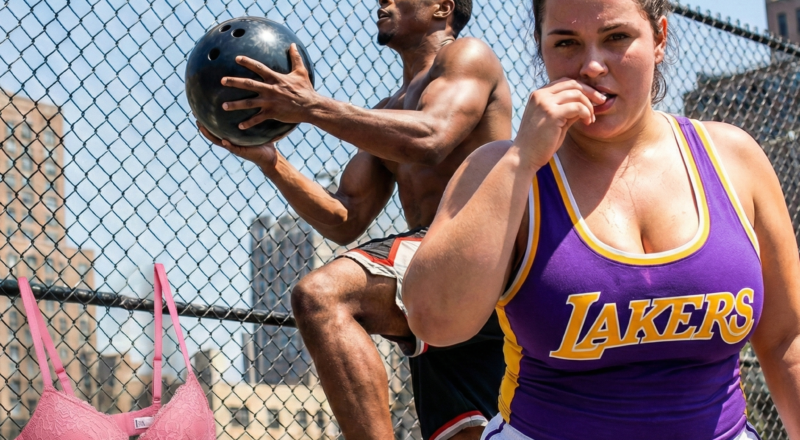
Basketball is a game of physics. Every dribble, pass, and shot is a practical application of Newton’s Laws of Motion. The equipment used is precision-engineered to maximize performance. The mistake in our puzzle—a player using a bowling ball on a basketball court—is a violation of the laws of elasticity and gravity. A bowling ball, made of dense urethane and weighing up to 16 pounds, has a “Coefficient of Restitution” near zero on concrete; it would not bounce, it would crack the pavement (and the player’s wrist).
This article explores the science of **Athletic Performance**, the economics of the **Sports Equipment Industry**, and the medical risks of high-impact sports.
- 1. The Physics of the Bounce: Elasticity and Air Pressure
- 2. Biomechanics and Injury Prevention
- 3. The Economics of the NBA and Global Sports
- 4. Material Science in Footwear: The Sneaker Industry
- 5. Urban Planning and Public Courts
- 6. The Psychology of Competition
- 7. Nutrition and Hydration for Athletes
- Conclusion: Play by the Rules of Physics
1. The Physics of the Bounce: Elasticity and Air Pressure
The error in the image highlights why a basketball is unique.
Coefficient of Restitution (COR): This measures how “bouncy” an object is. A regulation NBA basketball is an inflated bladder wrapped in leather or composite. When it hits the floor, the air inside compresses (storing potential energy) and then expands, pushing the ball back up. A bowling ball is solid; it dissipates energy as sound and heat (and damage to the floor), resulting in a “dead bounce.”
Air Pressure (PSI): A basketball must be inflated to between 7.5 and 8.5 PSI. The **Ideal Gas Law** dictates how this pressure changes with temperature. Playing on a hot outdoor court (like in the image) increases the pressure, making the ball bouncier.
2. Biomechanics and Injury Prevention
The man leaping in the background is putting immense stress on his body.
Ground Reaction Forces: When a player jumps, they exert force into the ground. When they land, the ground exerts an equal and opposite force back. Landing from a layup generates forces up to 8 times the player’s body weight. If that player were holding a 16lb bowling ball, the additional mass would drastically increase the load on the knees and ankles, likely causing an ACL tear or stress fracture.
Kinesiology: **Sports Medicine** doctors study these movements to prevent injury. Proper shooting form—using the legs for power and the wrist for guidance—is essential. Trying to shoot a bowling ball with standard basketball form would almost certainly result in a rotator cuff injury.
3. The Economics of the NBA and Global Sports
The jersey worn by the woman represents a massive global brand.
Merchandising and Licensing: The NBA is a global powerhouse. Merchandise sales (jerseys, hats, sneakers) contribute billions to revenue. The “Lakers” colors are legally protected trademarks.
Player Salaries and Salary Caps: NBA players are among the highest-paid athletes in the world. The economics of a team involve complex “Salary Cap” management to balance superstar contracts with the need for a deep roster. **Sports Agents** negotiate these deals, taking a percentage (usually 3-4%) as their fee.
4. Material Science in Footwear: The Sneaker Industry
The high-tops worn by the player are marvels of engineering.
Energy Return Foams: Companies like Nike and Adidas invest millions in R&D to create midsole foams (like Boost or Zoom Air) that return energy to the athlete, allowing them to jump higher and run faster.
Ankle Support: The debate between High-Tops vs. Low-Tops is ongoing. While high-tops provide proprioceptive feedback (making the ankle feel secure), studies show they do not necessarily prevent sprains better than low-tops. Strengthening the muscles via **Physical Therapy** is the only true prevention.
5. Urban Planning and Public Courts
The outdoor court setting is a staple of city life.
The “Rucker Park” Effect: Legendary street courts are cultural landmarks. They provide “Social Capital” to neighborhoods, serving as gathering places that foster community.
Surface Materials: Outdoor courts are usually asphalt or concrete. These surfaces are hard on joints (high impact) and abrasive on shoes/balls. Modern courts use specialized acrylic coatings (like Plexipave) to provide grip and slight cushioning. Maintenance of these courts is a key part of **Municipal Parks and Rec** budgets.
6. The Psychology of Competition
The intense focus on the woman’s face is the “Game Face.”
Performance Anxiety: The “Yips” is a condition where athletes suddenly lose the ability to perform basic motor skills (like shooting a free throw). Sports Psychologists work with athletes to develop mental toughness and visualization techniques.
Flow State: Being “in the zone” is a state of total immersion where time seems to slow down. Achieving this state requires a balance between skill level and challenge difficulty. Trying to play with a bowling ball would break this state instantly due to frustration.
7. Nutrition and Hydration for Athletes
The sweat visible on the players indicates high exertion.
Electrolyte Balance: Sweat isn’t just water; it contains sodium, potassium, and magnesium. Losing too much leads to cramping. **Sports Nutritionists** design hydration plans involving isotonic drinks to replenish these minerals.
Caloric Burn: Basketball is a high-intensity interval sport. A competitive game can burn 600-900 calories per hour. Athletes require a high-carbohydrate diet to fuel their glycogen stores for this explosive activity.
Conclusion: Play by the Rules of Physics
Basketball is a beautiful game because it flows. The ball bounces, the players fly, and the net swishes. Introducing a bowling ball into this system stops the flow instantly. It reminds us that while we can push the limits of human performance, we cannot break the laws of physics.
By spotting the mistake in this court scene, you are recognizing the materials that make the game possible. In sports, as in life, using the right tool for the job is the first step to victory.
Scroll back up to the image. Did you check the ball? Did you see the finger holes? Nothing but net… unless it’s a strike.
