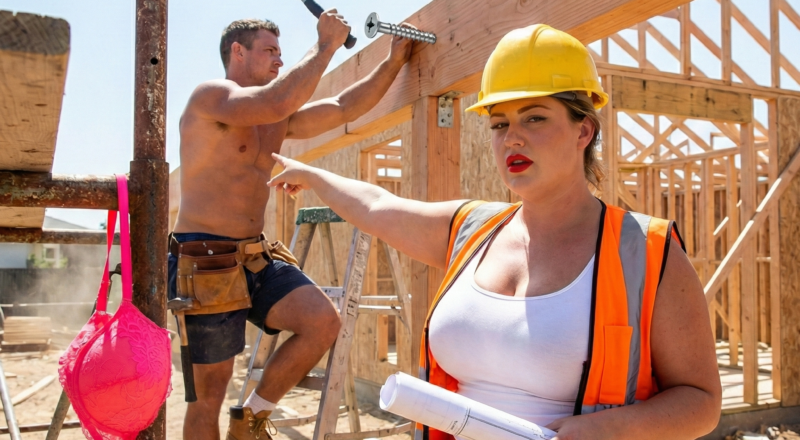
The construction industry is the backbone of the global economy, a sector worth over $10 trillion annually. It creates the infrastructure of our lives, from the homes we live in to the bridges we cross. At the microscopic level, this massive industry relies on simple physics: friction, tension, and shear force. The mistake in our puzzle—a worker hammering a screw—is a violation of these mechanical principles. While it might seem like a small error, using the wrong fastener can lead to structural failure, costly rework, and safety hazards.
This article explores the engineering differences between nails and screws, the strict safety regulations of **OSHA**, and the complex economics of **Project Management**.
- 1. The Physics of Fasteners: Nails vs. Screws
- 2. Construction Safety and OSHA Regulations
- 3. Material Science: Wood and Timber Framing
- 4. Construction Project Management (CPM)
- 5. The Skilled Trades Gap
- 6. Tools and Technology
- 7. Sustainable Building and LEED Certification
- 8. Women in Construction
- Conclusion: Building it Right
1. The Physics of Fasteners: Nails vs. Screws
The error in the image highlights the fundamental difference in how these two fasteners work.
Nails (Shear Strength): Nails are smooth metal pins. They rely on friction against the wood fibers to stay in place. However, their primary strength is “Shear Strength”—the ability to resist sliding forces. This is why nails are used for framing houses (like the one in the background). If a wall shifts in the wind, nails bend but don’t break.
Screws (Tensile Strength): Screws have spiral threads. They rely on “Tensile Strength”—the ability to resist being pulled out. The threads bite into the wood, creating a mechanical lock. However, screws are brittle. Under heavy shear force (like an earthquake), a screw will snap. Hammering a screw destroys the wood fibers that the threads need to grip, rendering it useless.
2. Construction Safety and OSHA Regulations
The Personal Protective Equipment (PPE) worn by the woman (Hard Hat, High-Vis Vest) is mandated by law.
The Occupational Safety and Health Administration (OSHA): In the US, OSHA sets the rules for job site safety.
- Head Protection: Hard hats (ANSI Z89.1) protect against falling objects and electrical shock. They must be worn square on the head, not backwards (unless designed for it).
- Fall Protection: Falls are the leading cause of death in construction (“The Fatal Four”). OSHA requires fall protection (harnesses) for anyone working above 6 feet. The man on the ladder in the puzzle would likely need fall arrest gear depending on the height.
The Cost of Non-Compliance: OSHA fines can reach hundreds of thousands of dollars. Beyond fines, a poor safety record increases **Workers’ Compensation Insurance** premiums, making it harder for a contractor to bid on jobs.
3. Material Science: Wood and Timber Framing
The wooden frame in the background represents the most common building method in North America.
Softwood Lumber: Houses are typically framed with “Softwood” (Pine, Fir, Spruce). This wood is strong in compression but lightweight.
Moisture Content: “Green” lumber contains moisture. As it dries, it shrinks. Builders must account for this movement to prevent drywall cracks. Using a moisture meter is a standard quality control step.
Engineered Lumber: Modern construction increasingly uses engineered wood like LVL (Laminated Veneer Lumber) or I-Joists. These are stronger and straighter than natural wood, allowing for open floor plans with fewer support columns.
4. Construction Project Management (CPM)
Building a house is a logistical puzzle.
The Critical Path Method (CPM): Project Managers use CPM to calculate the shortest possible time to complete a project. It identifies which tasks depend on others (e.g., you can’t install drywall before the electrical is inspected). A delay in a “Critical Path” task delays the entire project.
Supply Chain Issues: The price of lumber is volatile. A spike in lumber futures (as seen in 2021) can add $30,000 to the cost of a new home overnight. Contractors use “Escalation Clauses” in contracts to protect themselves from these price swings.
5. The Skilled Trades Gap
The workers in the image represent a shrinking workforce.
Labor Shortage: There is a massive global shortage of skilled tradespeople (carpenters, electricians, plumbers). As the “Baby Boomer” generation retires, there are not enough young workers replacing them.
Vocational Education: This has led to a renewed focus on “Career and Technical Education” (CTE). Trade schools offer a path to high-paying careers without the crushing student loan debt associated with four-year universities. A master electrician can earn a six-figure salary.
6. Tools and Technology
The hammer and blueprint are evolving.
BIM (Building Information Modeling): Paper blueprints are being replaced by tablets running BIM software. This allows architects, engineers, and contractors to view a 3D model of the building. It detects “clashes” (e.g., a duct running through a beam) before construction begins, saving millions in rework.
Power Tools: The cordless revolution has changed the job site. Lithium-ion batteries now power everything from circular saws to jackhammers, eliminating trip hazards from extension cords.
7. Sustainable Building and LEED Certification
Modern construction is green.
LEED (Leadership in Energy and Environmental Design): This is the most widely used green building rating system. Points are awarded for using recycled materials, energy-efficient windows, and reducing waste.
Passive House Standards: This is a rigorous standard for energy efficiency. It requires the building to be airtight and super-insulated, reducing heating and cooling energy use by up to 90%. Using the wrong fastener in the wrong place (creating a “Thermal Bridge”) can compromise this envelope.
8. Women in Construction
The woman in the foreground represents a demographic shift.
Breaking the Glass Ceiling: Historically male-dominated, the construction industry is actively recruiting women. Organizations like “National Association of Women in Construction” (NAWIC) provide mentorship and networking. Women are increasingly moving into roles like Project Management, Safety coordination, and heavy equipment operation.
Conclusion: Building it Right
Construction is the art of turning a drawing into a reality. It requires a respect for materials and a knowledge of physics. You can’t cheat the math. If you hammer a screw, the connection will fail. If you ignore safety, people get hurt.
By spotting the mistake in this construction site, you are honoring the precision and skill required to build the world around us. Whether it’s a skyscraper or a birdhouse, the right tool makes all the difference.
Scroll back up to the image. Did you check the tool belt? Did you see the threads? Twist, don’t pound.
