The Psychology of Trust: Why We Let Strangers Hold Sharp Objects
Getting a haircut is one of the most intimate commercial transactions we engage in. We walk into a room, sit in a chair, and allow a stranger to stand behind us wielding sharp steel blades near our eyes, ears, and jugular vein. We do this because of a social contract built on trust and professional standards. We assume that the person holding the scissors knows what they are doing and, more importantly, is using the correct tools for the job. But what happens when that trust is misplaced? What happens when the visual cues of “professionalism” blind us to a glaring safety hazard?
The mistake in this puzzle challenges that assumption. It presents a scene that looks, at first glance, like a high-end grooming experience. The lighting is perfect, the client is handsome, and the stylist looks focused. But hidden in the mechanics of the cut is a tool error so absurd that it defies the laws of physics and common sense. It reminds us that context is everything—and sometimes, context can trick us into seeing what we expect to see rather than what is actually there.
The Ritual of the Salon
To solve this mystery, we have to look at the scene without the filter of our expectations. Usually, when we see a salon, our brain auto-fills the details: mirrors, combs, spray bottles, and scissors. This is a mental shortcut called “schema processing.” Our brain has a “Salon Schema” that includes standard equipment. When we glance at the image, our brain ticks the boxes: “Is there a chair? Yes. Is there a cape? Yes. Is she cutting hair? Yes.” It skips the critical step of verifying the *nature* of the cutting implement.
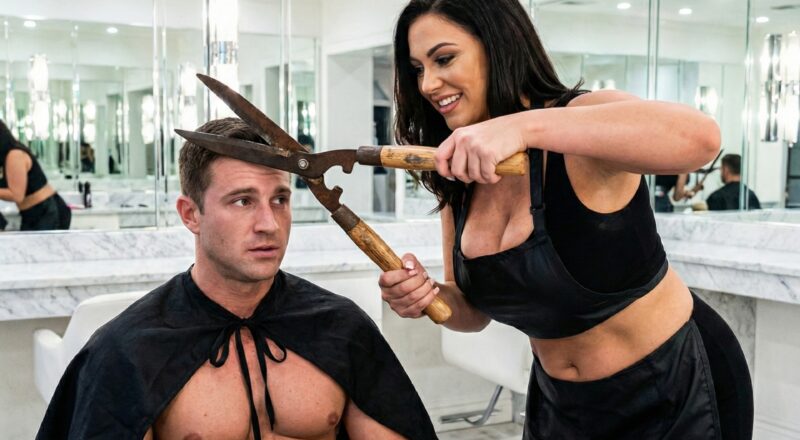
Take a closer look at the interaction between the stylist and the client. The man in the chair looks a bit nervous—and for good reason. While the woman in the foreground exudes confidence, her choice of equipment suggests she might be better suited for landscaping than barbering. The error isn’t in the background; it isn’t a reflection in the mirror. It is the primary action of the image.
The decoy objects—like the bright neon pink item on the counter or the shirtless physique of the client—are designed to hold your attention. They act as “visual anchors,” keeping your eyes locked on the safe, familiar parts of the image while the dangerous element hides in plain sight. This is the same principle used by pickpockets: distract the eye with movement or color, and the hand goes unnoticed.
The Physics of the Cut
Why does the specific tool matter? Beyond the obvious safety concerns, hair cutting is a matter of microscopic precision. Human hair is tough—it has the tensile strength of copper wire of the same diameter. To cut it cleanly without crushing the cuticle (which causes split ends), you need shears with a razor-sharp edge and a specific tension. The blades must bypass each other with zero gap.
Now, look at the tool in the woman’s hands. Does it look like it has that kind of precision? Does it look like it was designed for fine, protein-based strands, or does it look like it was designed to hack through woody stems and branches? The leverage required to operate this tool is immense. Using it near a human ear would be a game of Russian Roulette. The physics of the scene simply do not add up.
In the world of professional development, using the right tool for the job is a metaphor for competence. You wouldn’t use a sledgehammer to hang a picture frame, and you wouldn’t use a spreadsheet to write a novel. Recognizing the mismatch between the objective (a haircut) and the method (the tool) is a key skill in career growth. It distinguishes the expert from the amateur.
The Solution to the Puzzle
Have you spotted the disaster yet? If you look at the woman’s hands, you will see she is not holding barber scissors. She is wielding a massive, rusty pair of Garden Hedge Shears. This is the mistake. These long-handled pruning tools are designed for shaping bushes and trimming tree branches, not for styling human hair.
The sheer size of the blades is comical. They are nearly as big as the client’s head. Functionally, these shears work by crushing and tearing thick plant matter. If used on hair, they would likely pull the hair out by the root rather than slice it. Furthermore, the rusty condition of the metal implies a lack of sanitation that would shut down any legitimate business instantly.
The image plays on the visual similarity between scissors and shears—they both have two blades and a pivot point—but the scale and the application are completely wrong. She is treating the man like a shrubbery.
Why This Mistake Matters
Why do we need to train our brains to spot these incongruities? Because in life, “credentialing” is often just a costume. Just because someone looks the part (wearing the apron, standing in the salon) doesn’t mean they have the skills or the tools to deliver results. This applies to hiring a contractor, choosing a financial decision advisor, or picking a business partner.
We often fall for the “Halo Effect,” where one positive trait (a nice salon) makes us assume everything else is positive (the haircut will be good). Spotting the hedge shears is about breaking that Halo Effect. It’s about verifying the technical details before you commit. It’s the visual equivalent of checking references or reading the fine print.
In your online strategy, this attention to detail is crucial for quality control. It’s about noticing when a process is using “blunt force” (like hedge shears) when it requires “surgical precision” (like barber scissors). Efficiency isn’t just about getting it done; it’s about getting it done with the appropriate level of care.
What This Says About You
If you spotted the hedge shears immediately, you are a “pragmatist.” You focus on function. You likely looked at the action and asked, “Does that work?” You are the type of person who spots safety hazards or logistical flaws in a plan before they become problems.
If you missed it at first, you might be a “social processor.” You focused on the people—their expressions, their attractiveness, the mood of the room. While this makes you great at reading vibes and emotions, practicing these logic puzzles can help you sharpen your technical observation skills. It reminds you to look at the *what* and the *how*, not just the *who*.
So the next time you sit in that chair, take a quick glance at the mirror. Make sure the person behind you is holding the right kind of steel. Your ears will thank you.
Enjoyed this challenge?
Try our
another brain challenge
to test your observation skills.