The Physics of the Bounce: Why Material Science Rules the Court
Basketball is a game of rhythm. It is defined by the sound of the squeak on the hardwood and the rhythmic thump-thump-thump of the ball hitting the floor. This rhythm is made possible by a specific physical property called “elasticity.” When a basketball hits the ground, the air inside compresses, storing potential energy, which is then released as kinetic energy, pushing the ball back up. It’s a perfect loop of physics that allows the game to exist. But what happens when you replace that carefully engineered sphere with something organic? Something designed by nature to stay put, not to bounce?
The mistake in this puzzle challenges your brain’s ability to separate “form” from “function.” We see a scene that screams “Basketball.” We have the court, the players, the athletic stance, and the intensity. Our brain creates a mental shortcut: “They are playing a game.” Because of this shortcut, we might overlook the fact that the central object of the game—the ball itself—is fundamentally wrong. It is an error that violates the basic laws of material science and would end the game in a messy disaster within seconds.
The Geometry of the Game
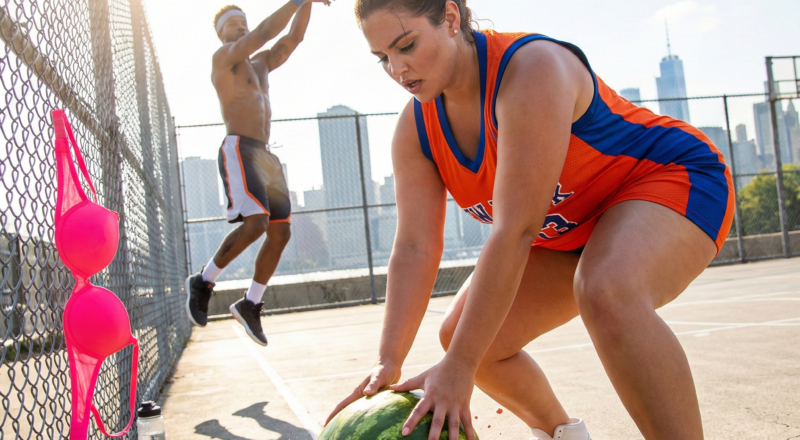
To solve this mystery, you need to pause your assumption that “everything here belongs.” In visual puzzles, context is often used as a trap. We assume that because the woman is wearing a jersey and sneakers, the object in her hand must be a basketball. This is called “Contextual Priming.” Your brain is primed to see sports equipment. To find the error, you have to look at the texture, the color, and the shape of that equipment.
Consider the mechanics of dribbling. It requires a “Coefficient of Restitution”—a fancy physics term for bounciness. A regulation NBA basketball has a high coefficient. It returns about 60-70% of the energy you put into it. A rock has a low coefficient. A tomato has a coefficient of zero (it splatters). The object in this image falls into the “splatter” category. If the woman were to actually push it toward the concrete as her posture suggests, the result wouldn’t be a crossover dribble; it would be a cleanup on Aisle 4.
The decoy objects—like the shirtless defender flying through the air or the bright neon pink item on the fence—are there to keep your eyes moving around the perimeter. They add to the chaotic energy of a streetball game. The more your eyes dart around looking at the “action,” the less time you spend analyzing the “object.”
The Evolution of Sports Technology
Why does the specific ball matter? The history of sports is essentially a history of materials. Early soccer balls were made of pig bladders. Early golf balls were made of wood. As our understanding of smart investment in materials grew, so did the speed and safety of our games. Today, a basketball is a marvel of composite leather and nylon windings. It is engineered to be perfectly spherical and balanced.
Replacing this engineering with a biological object is a comedic failure of logic. It reminds us that tools are purpose-built. You can’t force an object to do a job it wasn’t designed for, no matter how much talent or effort you apply. This is a crucial lesson in career growth and management: putting the right person (or tool) in the right role is 90% of the battle. If you try to force a creative “watermelon” into a rigid “basketball” role, you’re just going to make a mess.
In the world of digital skills and online strategy, we often see businesses trying to use outdated or mismatched tools to solve modern problems. They try to “dribble” with software that wasn’t designed for the task, leading to crashes and frustration. Recognizing when your equipment is the bottleneck is the first step toward optimization.
The Solution to the Puzzle
Have you spotted the juicy error? If you look closely at the object the woman is dribbling, you will see it is not a basketball. It is a large, striped Green Watermelon. This is the mistake. While it is roughly the same size and shape as a basketball, it lacks the essential property of elasticity.
The visual clue is in the stripes. Basketballs are orange with black ribs. This object has the distinct dark and light green variegated pattern of a melon. Furthermore, the surface is smooth and shiny, lacking the “pebbled” texture of leather necessary for grip. If she were to complete the motion of dribbling, the watermelon would hit the asphalt and shatter into pieces. The physics of the scene are impossible.
The image creates a humorous contrast between the intense, athletic determination of the players and the fragile, edible nature of the “ball.” It’s a slam dunk of absurdity.
Why This Mistake Matters
Training your eye to spot “Material Inconsistencies” is a valuable skill. In the physical world, it helps you identify quality and safety issues. If a structural beam looks like it’s made of the wrong material, or if a tire looks like it lacks the proper tread, noticing that detail can prevent accidents.
In the abstract world of financial decision making, it helps you spot “fake assets.” Just because something is round and green doesn’t mean it’s money (or a basketball). You have to verify the substance, not just the shape. Investing in a “watermelon” when you need a “basketball” is a quick way to lose your capital.
Moreover, this puzzle tests your ability to resist “Automatic Processing.” We are so used to seeing basketballs on courts that we stop really *seeing* them. We just register “Ball.” By forcing you to stop and identify “Watermelon,” the puzzle breaks that automatic loop and forces conscious engagement.
What This Says About You
If you spotted the watermelon immediately, you are a “Realist.” You pay attention to textures and materials. You aren’t easily fooled by the general “vibe” of a situation; you look at the concrete facts. You are the person who checks the ingredients label before buying the food.
If you focused on the players or the decoy first, you are likely an “Action-Oriented” thinker. You focus on movement and human dynamics. You saw the game being played before you saw the tools being used. While this makes you a great team player, remembering to check the equipment is a good habit to build.
So the next time you hit the court, check your ball. If it sounds hollow, you’re good. If it sounds ripe, you might want to bring a knife instead of your sneakers.
Enjoyed this challenge?
Try
this fun brain puzzle
to test your observation skills.