The Geometry of Success: Why You Cannot See the Whole Picture Alone
In a culture that often celebrates the “self-made” individual, it is easy to fall into the trap of believing that we must do everything ourselves. We prize independence, self-reliance, and the solitary genius. However, there is a fundamental flaw in this way of thinking, and it has nothing to do with intelligence or effort. It has to do with physics and biology.
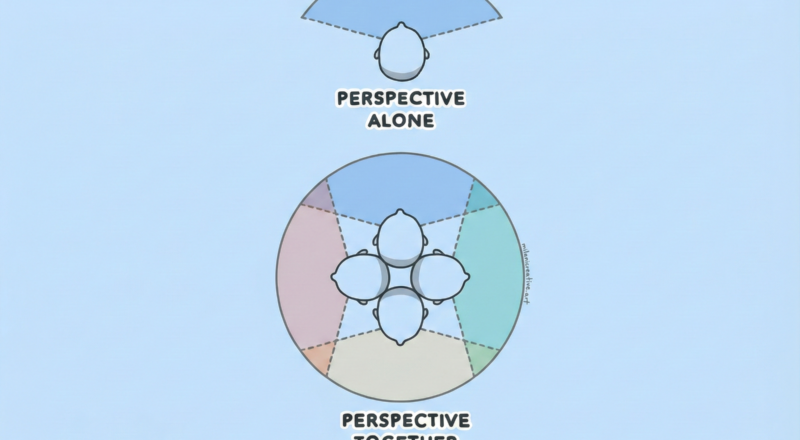
There is a limit to what one pair of eyes can see. The image of “Perspective Alone” versus “Perspective Together” perfectly illustrates a simple truth: Collaboration isn’t just about sharing the workload; it is about expanding reality.
The Trap of Perspective Alone
Look at the top half of the diagram. You see a single head looking forward. The blue cone represents their field of vision. It is clear, it is focused, but it is narrow. This represents us when we work in isolation.
When you are operating alone, you are subject to several cognitive limitations:
- Tunnel Vision: You become so focused on the goal ahead that you miss the opportunities (or dangers) approaching from the side.
- Confirmation Bias: Without anyone to challenge your thoughts, you tend to only see information that confirms what you already believe.
- The Blind Spot: This is the most dangerous area. It represents the “unknown unknowns.” These are the things you don’t even know that you don’t know.
The Emotional Cost of Isolation
Beyond the practical limitations, “Perspective Alone” carries a heavy emotional toll. When you are the sole viewer of your life, every problem feels massive. You have no benchmark for comparison. A small hurdle can look like a mountain because you have no one standing at a different angle to tell you, “Actually, there is a path right around the back.”
The Power of Perspective Together
Now, consider the bottom half of the image. Here we see four individuals arranged in a circle. Each person has the same limited field of vision as the person at the top. However, because they are arranged together, looking outward in different directions, something profound happens.
They create a complete circle. A 360-degree view of reality.
This is the definition of a high-functioning team, a healthy family, or a strong friendship group. This setup offers distinct advantages:
- Safety: There are no blind spots. If a threat approaches from behind, the person facing that way alerts the group. You are covered.
- Innovation: Notice where the colored cones overlap? That is where innovation happens. It is where my idea meets your idea, and we create a third, better idea that neither of us could have found alone.
- Empathy: Understanding that your view is only 25% of the picture forces you to listen. It kills the ego and births empathy.
Why We Resist “Together”
If the bottom image is clearly superior, why do so many of us stay stuck in the top image? Why do we choose “Perspective Alone”?
The answer is usually vulnerability.
To move from the top image to the bottom image, you have to admit that your view is incomplete. You have to admit that you need others. In a professional setting, this can feel like weakness. In a relationship, it can feel like losing an argument. But true strength is not pretending you know everything; true strength is building a circle of people who know the things you don’t.
Practical Insights for Your Life
How do we move from being the lonely figure to being part of the circle? Here are actionable steps for work and life:
In the Workplace
- Diversify Your Table: If everyone on your team looks like you, thinks like you, and has the same background as you, you are all facing the same direction. You don’t have a circle; you just have a louder version of “Perspective Alone.” Hire for difference.
- Invite Dissent: Ask your team, “What am I missing?” Reward the person who points out the blind spot rather than punishing them for being negative.
In Relationships
- The “Beach Ball” Analogy: Imagine a beach ball that is red on one side and blue on the other. You are standing on the red side; your partner is on the blue side. You are shouting, “It’s red!” and they are shouting, “It’s blue!” You are both right, but you are both incomplete. You need their perspective to see the whole ball.
- Listen to Learn, Not to Respond: When someone shares a view that contradicts yours, treat it as data, not an attack. They are describing the part of the circle you cannot see.
The Takeaway
We are biologically wired for connection. The image shows us that while we are capable individuals, we are complete only when we are connected.
The next time you feel stuck, overwhelmed, or confused, stop trying to squint harder at the view in front of you. Instead, ask yourself: “Who can I invite into my circle to show me what I’m missing?”
You don’t need better eyes. You just need more perspectives.
