Why You Must Learn to Fight: Moving From Fragility to Fortitude
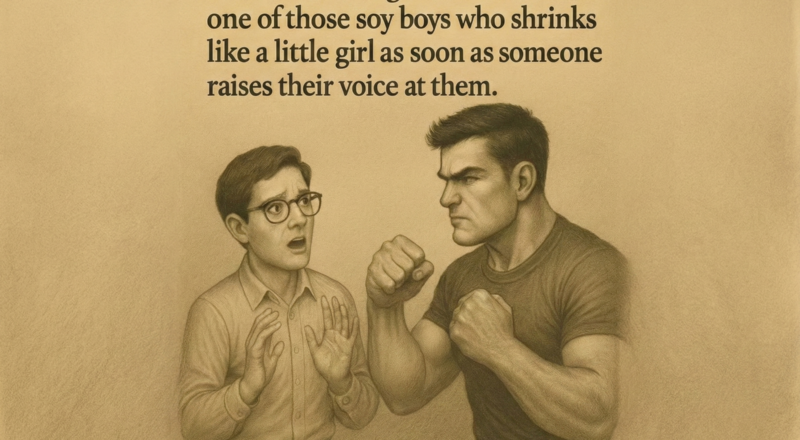
In modern society, we often confuse being “harmless” with being “good.” We teach children to be nice, to be agreeable, and to avoid conflict at all costs. However, as the image above starkly illustrates, there is a profound difference between being a peaceful person and being a harmless one. The image captures a primal dynamic: one man stands ready and assertive, while the other shrinks away in fear at the first sign of aggression.
The caption, “Learn How to Fight,” serves as a provocative wake-up call. It challenges the viewer to abandon the comfort zone of passivity. For a Western audience navigating competitive workplaces, complex social dynamics, and the pressures of modern life, this message is not about inciting violence—it is about cultivating the necessary capacity for aggression so that you can effectively negotiate peace.
The Dangerous Illusion of Harmlessness
There is a prevailing idea in the United States and Europe that if you are simply nice to everyone, everyone will be nice to you. This is a dangerous fallacy. The character on the left in the illustration represents the archetype of the “nice guy” who lacks boundaries. He is terrified of confrontation.
When you cannot say “no,” when you cannot defend your position, and when you shrink at the sound of a raised voice, you are not being moral; you are being obedient out of fear. This fragility leads to:
- Resentment: You say yes to things you hate because you are afraid to upset others.
- Invisibility: In boardrooms and social circles, those who shrink are often overlooked.
- Vulnerability: Predators, whether physical or psychological, look for easy targets.
What “Learning to Fight” Actually Means
To “learn how to fight” is a metaphor for developing capability. It is the process of integrating your “shadow”—the part of you that can be dangerous—so that you can control it. As the famous psychologist Jordan Peterson often notes, “A harmless man is not a good man. A good man is a very dangerous man who has that under voluntary control.”
1. Physical Confidence
There is an undeniable link between physical capability and mental fortitude. When you know, deep down, that you can defend yourself physically, your body language changes. You stop apologizing with your posture. You don’t need to actually fight people to reap the benefits of martial arts or strength training; the knowledge that you can handle yourself removes the desperate scent of fear that bullies thrive on.
2. Verbal Ju-Jitsu
Fighting is most often done with words. “Shrinking like a little girl,” as the image controversially phrases it, refers to the emotional collapse that happens during a verbal altercation. Learning to fight means:
- Maintaining eye contact when someone is shouting.
- Keeping your voice calm and level.
- Refusing to accept unearned guilt or shame.
- Articulating your boundaries clearly without stuttering.
The Psychology of the “Shrink” Response
Why do so many modern men and women shrink like the figure on the left? It comes down to a “fawn” response. In evolutionary psychology, when faced with a threat, we fight, flight, freeze, or fawn. Fawning is trying to please the aggressor to avoid harm.
The “soy boy” slur used in the image is internet slang, but it points to a real phenomenon: a perceived lack of testosterone, drive, and stoicism in modern behavior. It criticizes the tendency to be overly emotional, hyper-sensitive, and conflict-averse.
When you shrink, you are signaling to the world that your opinion, your space, and your dignity are less important than the aggressor’s comfort. Breaking this habit requires a conscious rewiring of your nervous system.
Practical Steps to Build Your “Fight”
If you identify more with the person on the left than the person on the right, do not despair. Fortitude is a muscle, and it can be built. Here is how you can stop shrinking and start standing tall.
Step 1: Engage in Voluntary Discomfort
You cannot become tough if your life is entirely soft. You need to simulate stress in a controlled environment so you don’t panic when real stress hits.
- Join a Gym or Dojo: Brazilian Jiu-Jitsu (BJJ), Boxing, or Muay Thai are excellent. They teach you that getting hit or crushed isn’t the end of the world.
- Cold Plunges: Forcing your body to withstand cold water trains your mind to override the “flight” impulse.
Step 2: Practice “Micro-Confrontations”
Stop avoiding small conflicts. These are your training grounds.
- If a barista gets your order wrong, politely ask for it to be fixed.
- If someone cuts you off in conversation, hold your hand up and say, “I wasn’t finished.”
- Negotiate a bill or a price, even if you don’t need the money. It practices the art of holding your ground.
Step 3: Fix Your Physiology
Your mind follows your body. If you slouch, look down, and cross your legs tightly, your brain produces cortisol (stress hormone). Adopt the “Power Pose”:
- Shoulders back and down.
- Chin parallel to the floor.
- Take up space. Do not fold yourself into corners.
- Breathe through your nose, deep into your belly.
The Lesson: Competence Leads to Peace
The ultimate irony of learning how to fight is that the better you get at it, the less you have to do it. The man on the right in the image likely gets into fewer actual scraps than the man on the left.
Why? Because bullies and aggressors are opportunistic. They look for weakness. When you project strength, competence, and a willingness to engage if necessary, people respect your boundaries naturally. They don’t raise their voice at you because they sense it won’t work.
Conclusion
The image above is a caricature, but the lesson is real. The world can be a hostile place. You have a choice: you can remain fragile, hoping that the world treats you with kid gloves, or you can “learn to fight”—physically, mentally, and emotionally. The goal isn’t to become a bully; the goal is to become a warrior in a garden, rather than a gardener in a war. Stand up, speak up, and stop shrinking.
