The Art of Radical Acceptance: How to Let Go of Control and Find Peace
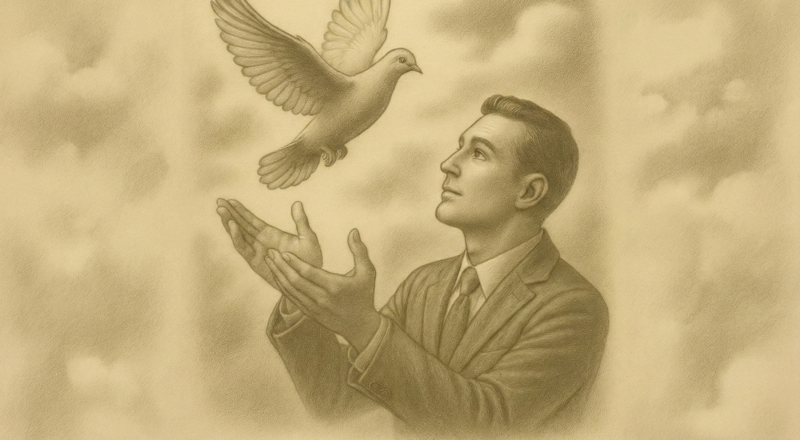
In a world that constantly tells us to “hustle,” “grind,” and “take charge,” the idea of letting go can feel counterintuitive. We are conditioned to believe that if we just worry enough, plan enough, or stress enough, we can bend reality to our will. But looking at the pencil sketch of the man releasing the dove, we are reminded of a timeless lesson that is essential for modern mental health: true power doesn’t come from gripping tighter; it comes from letting go.
The image is striking in its simplicity. A man in professional attire—representing our daily responsibilities and worldly status—looks upward with a calm expression, releasing a bird into the sky. The caption reads, “Accept and Let Go. Accept what you can’t control and ignore it.”
This isn’t just a motivational quote; it is a psychological tool for survival. Let’s dive deep into why accepting what you cannot control is the ultimate life hack for happiness and success.
The Illusion of Control
Why is it so hard for us to let go? Psychologists call this the “Illusion of Control.” It is the tendency for human beings to overestimate their ability to control events. We think that if we worry about a flight delay, the plane will somehow arrive faster. We think if we replay an awkward conversation in our heads a thousand times, we can retroactively fix it.
However, this need for control is often a mask for anxiety. We fear the unknown, so we try to micromanage every aspect of our lives. The result? Burnout, fatigue, and a constant state of “fight or flight.”
What We Actually Control vs. What We Don’t
To practice the philosophy in the image, we first need to perform a “Control Audit.” The Stoic philosophers, specifically Epictetus, taught that suffering arises when we try to control things that are not up to us. We need to clearly distinguish between the two categories.
- Things You Can Control: Your effort, your attitude, your words, your boundaries, how you treat others, and how you react to bad news.
- Things You Cannot Control: The weather, the economy, traffic, the past, the future, what other people think of you, and the outcome of your efforts.
The man in the image has realized that the bird (the outcome) must fly. He can only control his hands (the action of releasing).
Decoding the Image: “Accept and Let Go”
The visual metaphor here is profound. Let’s break down the elements:
- The Suit: The man is wearing a suit and tie. This signifies that “letting go” isn’t just for monks on a mountain. It is for people with jobs, families, and bills. You can be responsible and ambitious while still practicing detachment.
- The Open Hands: An open hand is a universal sign of peace and non-resistance. You cannot receive anything new if your hands are full of old baggage.
- The Dove: Historically, the dove represents peace, the soul, and freedom. By releasing the dove, the man is actually releasing himself.
The Psychology of “Ignoring It”
The second part of the caption is controversial to some: “Accept what you can’t control and ignore it.”
Does this mean we should be negligent? If your car breaks down, do you “ignore it”? Of course not. That is a misinterpretation. To “ignore” in this context means to starve the problem of your emotional energy.
When you encounter a situation you cannot change—like a rude coworker or a rainy wedding day—you have two choices:
- Option A: Ruminate, complain, and let it ruin your day.
- Option B: Acknowledge it exists, do what is necessary, and then “ignore” the emotional weight of it.
Ignoring the uncontrollable is a form of mental efficiency. It allows you to redirect your limited focus toward things that actually move the needle in your life.
Practical Steps to Master the Art of Surrender
How do we move from understanding this concept intellectually to actually living it? Here are practical steps to embody the “Accept and Let Go” mindset.
1. The “Pause and Label” Technique
When you feel your chest tighten with anxiety, pause. Ask yourself: “Is this problem within my control?” If the answer is no, visualize yourself putting that problem into a balloon and watching it float away. Label it as “Not Mine.”
2. Shift from “What If” to “Even If”
Anxiety loves “What if.” What if I get fired? What if they don’t like me? This is a fear-based loop.
Try changing the narrative to “Even if.”
“Even if I get fired, I have the skills to find a new job.”
“Even if they don’t like me, I like myself.”
This builds resilience rather than fear.
3. Practice Physical Release
The body keeps the score. If your mind is holding on, your body probably is too.
- Unclench your jaw.
- Drop your shoulders away from your ears.
- Open your hands, just like the man in the picture.
Sometimes, changing your physical posture is enough to signal to your brain that it is safe to let go.
Why Letting Go attracts Success
There is a paradox in life: the less needy you are, the more you attract. When you are desperate for a relationship, you repel people. When you are desperate for money, you make bad business decisions based on fear.
When you “Accept and Let Go,” you operate from a place of abundance. You do the work, and you detach from the result. This confidence is magnetic. In Western culture, we often mistake stress for caring. We think that if we aren’t stressed, we aren’t working hard enough. This image challenges that narrative. It suggests that the highest form of functioning is a calm, surrendered focus.
The Emotional Freedom of Acceptance
Imagine how much lighter you would feel if you dropped the heavy luggage of the past. Holding onto grudges, regrets, or “what could have been” is exhausting. It is like drinking poison and expecting the other person to get sick.
Acceptance is forgiveness. It is forgiving reality for not being exactly what you wanted it to be. It is making peace with the imperfection of life.
Conclusion: Your Takeaway
Look at the image one last time. The man looks up—he is looking toward the future, not down at his hands in regret.
Life is unpredictable. You will face storms you didn’t forecast and obstacles you didn’t create. You can choose to fight the waves and drown in exhaustion, or you can learn to surf.
Here is your challenge for today: Identify one thing that is stressing you out right now. Ask yourself, “Can I control this?” If the answer is no, take a deep breath, open your hands, and imagine that stress flying away like the dove. Accept it, ignore the worry, and reclaim your peace.
