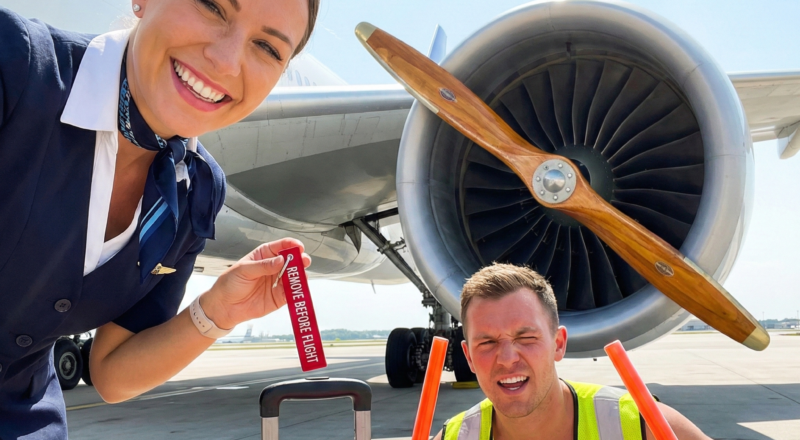
The commercial aviation industry is the pinnacle of modern engineering. Every time you board a flight, you are entrusting your life to a machine designed with incredibly tight tolerances and redundancy systems. The mistake in our puzzle—a modern jet engine fitted with an antique wooden propeller—is a humorous anachronism that highlights the massive technological leap from piston engines to gas turbines. While both generate thrust, they operate on fundamentally different principles. Understanding these differences is key to understanding **Aerospace Engineering**, global logistics, and the economics of travel.
This article explores the physics of lift and drag, the difference between Turbofans and Turboprops, and the rigorous safety standards of the **FAA** and **EASA**.
- 1. Propulsion Systems: Jet vs. Propeller
- 2. Aerodynamics: Lift, Weight, Thrust, and Drag
- 3. The Economics of Fuel Efficiency
- 4. Aviation Safety and Maintenance (MRO)
- 5. The Experience of Air Travel
- 6. Air Traffic Control (ATC) and Logistics
- 7. The Future of Flight: Electric and Supersonic
- 8. Aviation Law and Passenger Rights
- Conclusion: Cleared for Landing
1. Propulsion Systems: Jet vs. Propeller
The error in the image mixes two distinct eras of flight.
The Propeller (Piston/Turboprop): A propeller is essentially a rotating wing. As it spins, it creates a pressure difference (low pressure in front, high pressure behind) that pulls the airplane forward. This is efficient at low speeds and low altitudes. However, as an aircraft approaches the speed of sound, the tips of the propeller blades go supersonic, creating shockwaves that destroy efficiency and create massive noise. This is why propellers are rarely used on high-speed jets.
The Turbofan (Jet Engine): The engine depicted in the background is a “High-Bypass Turbofan.” It sucks in massive amounts of air, compresses it, mixes it with fuel, ignites it, and blasts it out the back. This reaction force (Newton’s 3rd Law) pushes the plane forward. The large fan at the front (which should be titanium, not wood) provides most of the thrust by bypassing air around the core.
2. Aerodynamics: Lift, Weight, Thrust, and Drag
Flight is a balancing act of four forces.
Bernoulli’s Principle: This principle explains how wings create lift. Because the air moves faster over the curved top surface of the wing, the pressure decreases. The higher pressure under the wing pushes it up.
Drag Coefficients: Engineers spend millions of hours in wind tunnels trying to reduce “Parasitic Drag” (air resistance). A wooden propeller on a jet would create immense drag, likely tearing the engine apart before the plane even left the ground.
3. The Economics of Fuel Efficiency
Why do airlines care about engines so much? Money.
Fuel Costs: Jet fuel (Kerosene/Jet A-1) is typically an airline’s single biggest expense, accounting for 20-30% of operating costs.
Bypass Ratio: Modern engines are getting wider and wider. A higher “Bypass Ratio” (more air going around the core than through it) equals better fuel efficiency. This is why the engines on a Boeing 777 or Airbus A350 are so massive—they are essentially giant ducted fans designed to sip fuel, saving airlines billions over the lifespan of the fleet.
4. Aviation Safety and Maintenance (MRO)
The “Remove Before Flight” tag held by the woman is a critical safety device.
Pre-Flight Checks: These red tags are attached to covers on pitot tubes (speed sensors) and static ports. If a pilot forgets to remove them, the plane’s computers won’t know how fast it’s flying, which can lead to catastrophic crashes.
MRO (Maintenance, Repair, and Overhaul): Airlines operate on strict maintenance schedules. An “A-Check” happens every few months, while a “D-Check” happens every few years and involves taking the entire plane apart. This MRO industry is a massive employer of skilled mechanics and engineers.
5. The Experience of Air Travel
The flight attendant represents the service side of the industry.
Cabin Crew Training: Flight attendants are not just servers; they are safety professionals. Their training focuses heavily on evacuation procedures, firefighting at 30,000 feet, and medical emergencies. They are the first line of defense in a security incident.
Class Segmentation: Airlines maximize revenue through “Price Discrimination.” Business Class and First Class passengers subsidize the Economy tickets. The lie-flat seats and premium service are designed to attract high-net-worth business travelers who value time and comfort over cost.
6. Air Traffic Control (ATC) and Logistics
The busy tarmac implies a complex choreography.
The Marshaller: The man with the wands is a Marshaller. He uses standardized hand signals to guide the pilot to the gate. Pilots have limited visibility on the ground and rely entirely on ground crew to avoid hitting wingtips.
Slot Management: Airports like Heathrow or JFK are “Slot Constrained.” An airline must pay millions just for the right to land and take off at a specific time. Losing a slot due to delays is a financial disaster.
7. The Future of Flight: Electric and Supersonic
Where goes aviation go from here?
Electric Aviation: For short-haul flights, companies are developing battery-powered planes. These often use propellers, bringing the technology full circle—but they are high-tech composite props, not the wooden one in our puzzle!
Supersonic Return: Startups like Boom Supersonic are trying to bring back commercial supersonic flight (faster than sound), which ended with the Concorde. The challenge is managing the “Sonic Boom” so it doesn’t disturb people on the ground.
8. Aviation Law and Passenger Rights
What happens when things go wrong?
The Montreal Convention: This international treaty governs airline liability for lost bags, delays, and injuries. It sets the compensation limits for passengers.
Overbooking: Airlines legally overbook flights because they know a certain percentage of people won’t show up. When everyone shows up, they must offer vouchers to “bump” volunteers. Understanding these rights can be very profitable for the savvy traveler.
Conclusion: Cleared for Landing
Aviation is a field where “good enough” is not acceptable. Perfection is the standard. Every rivet, every sensor, and every fan blade is tested to the breaking point. A wooden propeller on a jet is a funny image, but it represents a failure to understand the extreme forces at play in the sky.
By spotting the mistake in this tarmac scene, you are showing that you have the eye for detail required to keep things flying smooth and level.
Scroll back up to the image. Did you check the intake? Did you see the wood? Wheels up.
