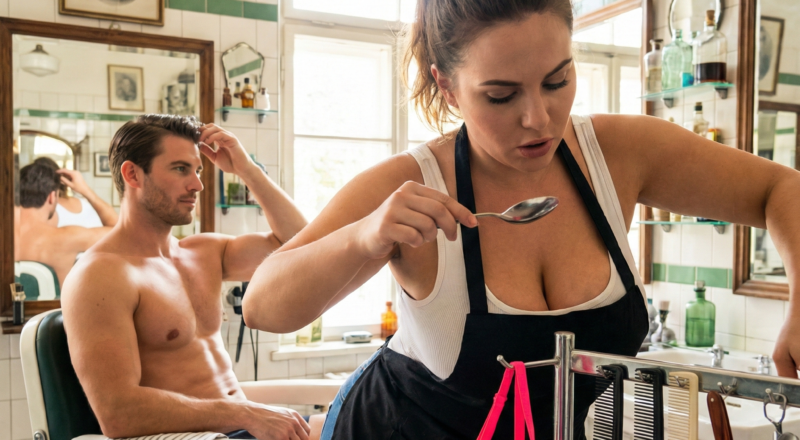
The global men’s grooming industry is currently undergoing a renaissance, valued at over $80 billion globally. The humble barber shop has transformed from a quick-service stop into a high-end “lifestyle destination” offering hot towel shaves, facials, and precision styling. However, at the core of this industry is technical skill and the proper use of tools. The mistake in our puzzle—a barber trying to cut hair with a spoon—is a humorous violation of physics and function. In reality, the tools of the trade are precision-engineered instruments, and using the wrong one is not just ineffective; it is a liability risk.
This article explores the economics of running a barber shop, the rigorous State Board hygiene regulations, and the science of hair biology.
- 1. The Tools of the Trade: Precision Engineering
- 2. State Board Regulations and Sanitation
- 3. The Economics of the Chair Rental Model
- 4. Hair Biology and Trichology
- 5. Men’s Mental Health and the “Third Place”
- 6. Marketing and Branding in the Digital Age
- 7. Product Sales and Retail Revenue
- Conclusion: The Sharpest Look
1. The Tools of the Trade: Precision Engineering
The error in the image highlights the importance of the correct instrument.
Shears (Scissors): Professional barber shears are made from high-grade Japanese or German steel (like Hitachi 440C or VG-10). They are hollow-ground to a razor edge. A single pair can cost upwards of $1,000. Using a dull tool (or a spoon!) damages the hair cuticle, causing split ends and a frizzy finish.
Clippers and Trimmers: Modern clippers use magnetic or rotary motors to drive blades at thousands of strokes per minute. Maintaining these tools—cleaning, oiling, and aligning—is a daily ritual.
The Straight Razor: The hallmark of a master barber. Using a straight razor requires a steady hand and an understanding of skin geometry to perform a “Close Shave” without causing “Razor Burn” or cuts.
2. State Board Regulations and Sanitation
The barber shop is a regulated environment.
Licensing Requirements: To become a barber, one must complete typically 1,500 hours of training at a **Barber College** and pass a state licensing exam. This training focuses heavily on sanitation and infectious disease control.
Barbicide and Disinfection: That jar of blue liquid (Barbicide) on the counter isn’t for decoration. It is a hospital-grade disinfectant. Tools must be submerged for a specific time (usually 10 minutes) between clients to prevent the spread of folliculitis, ringworm, or blood-borne pathogens.
Health Inspections: Shops are subject to random inspections. A violation—like reusing a razor blade or a dirty workstation—can result in fines or the revocation of the shop’s operating license.
3. The Economics of the Chair Rental Model
How do barbers make money?
Booth Rent vs. Commission:
- Booth Rent: Most experienced barbers are essentially independent contractors. They pay the shop owner a weekly fee (e.g., $200-$500) to rent the chair. They keep 100% of their service revenue but must provide their own tools, insurance, and marketing.
- Commission: Newer barbers often work on commission (e.g., a 60/40 split with the shop). This provides a steady flow of walk-in clients but caps earning potential.
The Value of a Client List: A barber’s most valuable asset is their “Book” (client list). A loyal client visits every 2-4 weeks. The **Lifetime Value (LTV)** of a single client who stays for 10 years can exceed $15,000.
4. Hair Biology and Trichology
Understanding what you are cutting is as important as how you cut it.
Trichology: This is the scientific study of the hair and scalp. Barbers are often the first to notice skin conditions like Alopecia (hair loss), Psoriasis, or Dandruff.
Hair Structure: Hair is made of a protein called Keratin. It has three layers: the Medulla (inner), Cortex (middle, providing strength and color), and Cuticle (outer protective scales). A sharp cut seals the cuticle; a bad cut shatters it.
5. Men’s Mental Health and the “Third Place”
The barber shop serves a vital social function.
The Third Place: Sociologist Ray Oldenburg defined the “Third Place” as a social surrounding separate from the two usual social environments of home (First Place) and the workplace (Second Place). For many men, the barber shop is their Third Place—a safe space to talk, vent, and bond.
Barbers as Confidants: Because of the physical touch and trust involved, clients often open up to their barbers about personal issues. Programs like “The Confess Project” are training barbers to be mental health advocates for their communities.
6. Marketing and Branding in the Digital Age
The handsome man in the chair represents the visual nature of the business.
Instagram and TikTok: Grooming is a visual medium. Successful barbers use social media to showcase their “Fades” and “Line-ups.” A viral transformation video can book a barber solid for months.
Booking Apps: The days of calling for an appointment are gone. Apps like Booksy or Squire allow clients to book, pay, and tip instantly. These platforms also help barbers manage their schedule and reduce “No-Shows” by charging cancellation fees.
7. Product Sales and Retail Revenue
Services are time-capped, but products are scalable.
Pomades and Beard Oils: Selling grooming products is a key revenue stream. Margins on retail products are typically 50%. A barber who educates their client on *why* they are using a specific matte clay or beard balm is far more likely to close the sale.
Private Labeling: Many enterprising barbers create their own product lines (“White Labeling”), building a brand that generates income even when they aren’t behind the chair.
Conclusion: The Sharpest Look
Barbering is an art form that requires the right tools, the right training, and the right touch. A spoon belongs in a soup bowl, not a haircut. When we try to force a tool to do a job it wasn’t designed for, the results are messy.
By spotting the mistake in this shop, you are recognizing that quality work demands quality instruments. In grooming, as in life, there are no shortcuts to looking sharp.
Scroll back up to the image. Did you check the hand? Did you see the spoon? Precision is everything.
