The global financial system is the central nervous system of the modern economy, moving trillions of dollars daily across borders and asset classes. From the traditional Stock Market (Equities) to the volatile world of Cryptocurrency and the massive Foreign Exchange (Forex) market, trading is a high-stakes environment defined by speed, data, and psychology. In this arena, the ability to process visual information rapidly and “spot the difference” between a market signal and market noise is the difference between immense profit and catastrophic loss.
This article explores the structure of modern financial markets, the rise of Algorithmic Trading, the psychology of investors, and the regulatory frameworks designed to maintain market integrity.
- 1. The Structure of Modern Markets
- 2. High-Frequency and Algorithmic Trading (HFT)
- 3. Behavioral Finance and Trading Psychology
- 4. Cryptocurrency and Decentralized Finance (DeFi)
- 5. Risk Management and Portfolio Diversification
- 6. Financial Regulation and Compliance
- 7. Fintech and the Democratization of Finance
- Conclusion: The Data-Driven Mindset
1. The Structure of Modern Markets
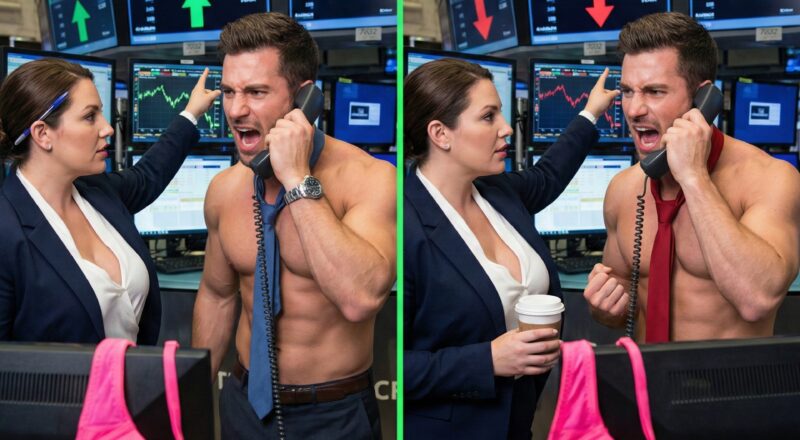
The chaotic environment depicted in the image represents the high-pressure reality of a trading desk.
Exchanges vs. OTC: Trading occurs on centralized exchanges like the New York Stock Exchange (NYSE) or NASDAQ, where prices are publicly displayed. Alternatively, Over-the-Counter (OTC) markets handle trades directly between two parties, often used for complex derivatives or bonds.
Market Makers and Liquidity: The smooth operation of markets depends on “Liquidity Providers” or Market Makers. These entities stand ready to buy or sell assets at publicly quoted prices, ensuring that traders can enter or exit positions quickly. Without sufficient liquidity, “Slippage” occurs, where the execution price is worse than the expected price.
2. High-Frequency and Algorithmic Trading (HFT)
While humans are visible in the image, the real volume is driven by machines.
Algorithmic Trading: Over 70% of US equity trading is now done by algorithms. These complex computer programs execute orders based on pre-defined criteria (timing, price, or quantity). They can “spot differences” in market inefficiencies in microseconds, far faster than any human.
High-Frequency Trading (HFT): A subset of algo trading, HFT firms use powerful computers and low-latency networks to transact a large number of orders at extremely high speeds. They profit from tiny price discrepancies. This “Latency Arbitrage” has led to an arms race for faster fiber optic cables and microwave towers to shave milliseconds off trade execution times.
3. Behavioral Finance and Trading Psychology
The stressed expressions of the traders highlight the human element that still drives volatility.
Cognitive Biases: Behavioral Finance studies how psychological influences and cognitive biases affect financial decisions. Biases like “Loss Aversion” (feeling the pain of a loss more than the joy of a gain) or “Confirmation Bias” (seeking only information that confirms existing beliefs) lead traders to make irrational decisions.
Fear and Greed Index: Market sentiment swings between two poles: Fear and Greed. When the market is crashing (represented by the red arrow in Difference #3), fear dominates, leading to panic selling. When the market is soaring, greed takes over, leading to bubbles. Successful traders master emotional regulation to avoid getting caught in the herd mentality.
4. Cryptocurrency and Decentralized Finance (DeFi)
The financial landscape is being disrupted by blockchain technology.
Bitcoin and Altcoins: Cryptocurrency operates 24/7 on decentralized networks. Unlike traditional stocks, crypto is highly volatile and largely unregulated. Investors must understand the technology behind the asset (e.g., Proof of Work vs. Proof of Stake).
Decentralized Finance (DeFi): DeFi aims to recreate traditional financial systems (lending, borrowing, trading) on the blockchain without intermediaries like banks. Using “Smart Contracts” on platforms like Ethereum, users can earn yield or trade assets peer-to-peer. This is a high-risk, high-reward frontier of finance.
5. Risk Management and Portfolio Diversification
Survival in finance is about managing downside.
Asset Allocation: The golden rule of investing is “Don’t put all your eggs in one basket.” Portfolio Diversification involves spreading investments across different asset classes (stocks, bonds, real estate, commodities) to reduce exposure to any single risk.
Hedging Strategies: Sophisticated investors use derivatives like Options and Futures to hedge against potential losses. For example, buying a “Put Option” protects an investor if a stock’s price falls below a certain level. Understanding these complex instruments is vital for institutional risk management.
6. Financial Regulation and Compliance
To prevent fraud and maintain stability, markets are heavily regulated.
Securities and Exchange Commission (SEC): In the US, the SEC oversees securities markets, protecting investors and maintaining fair, orderly, and efficient markets. They investigate “Insider Trading” and market manipulation.
Anti-Money Laundering (AML) and KYC: Financial institutions must adhere to strict AML and “Know Your Customer” (KYC) regulations to prevent the financial system from being used for illicit activities. Compliance departments are growing rapidly to keep up with evolving regulations in both traditional finance and crypto.
7. Fintech and the Democratization of Finance
Technology is making investing accessible to everyone.
Robo-Advisors: Platforms like Betterment or Wealthfront use algorithms to create and manage diversified portfolios for retail investors at a fraction of the cost of a traditional financial advisor.
Retail Trading Apps: Apps like Robinhood have brought millions of new traders into the market with commission-free trading and intuitive interfaces. While this democratizes access, it also raises concerns about the “Gamification” of investing and whether inexperienced traders understand the risks involved.
Conclusion: The Data-Driven Mindset
The financial world is a complex ecosystem of data, technology, and human psychology. Success requires more than just guessing which stock will go up. It requires a disciplined approach to analyzing information, managing risk, and controlling emotions.
By training your eye to spot the differences in this puzzle, you are practicing the rapid information processing required to navigate the fast-paced world of global finance. In the market, as in this game, the details determine the outcome.
Scroll back up to the image. Did you check the ticker arrow? Did you see the watch? Focus is the most valuable currency.
