The Psychology of Resilience: What True Mental Strength Looks Like
We often have a misconception about what mental strength actually is. Pop culture tells us that being “strong” means being stoic, emotionless, or unshakeable. We imagine the hero who never cries, never flinches, and always has a witty comeback in the face of disaster. But in the field of psychology, this is known as “emotional suppression,” and it is actually a sign of fragility, not strength. True mental strength—or resilience—is much more complex. It is the ability to feel deep pain, acknowledge the reality of a bad situation, and still make the choice to keep moving forward.
The mistake in our puzzle is a common one: confusing “calmness” with “competence.” It challenges you to look at a high-stress scenario and identify which person is actually processing the trauma in a healthy way, versus those who are either drowning in it or pretending it isn’t happening. Identifying this trait is crucial because, in a crisis, you want to be standing next to the person who is resilient, not the person who is numb.
The Three Responses to Trauma
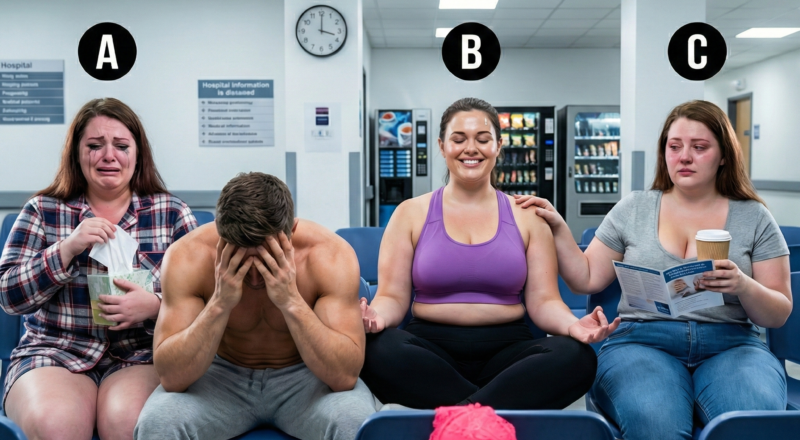
Take a look at the image provided. We are in a hospital waiting room at 3:00 AM. This is the universal setting for bad news. The air is thick with anxiety. We see three women reacting to the same stressful event, perhaps waiting for news on a loved one. At first glance, you might be drawn to the drama of the crying woman or the serenity of the meditating woman. But if you look closer, you will see three distinct psychological mechanisms at work.
When we face a threat, our brains trigger the “Fight, Flight, or Freeze” response. But there is a fourth response called “Face.” This is the cognitive choice to confront the situation. It requires a balance between the emotional brain (the Amygdala) and the logical brain (the Prefrontal Cortex). A person who is purely emotional cannot function. A person who is purely logical is often in denial. The mentally strongest person is the one who integrates both.
To solve this puzzle, you need to look for signs of “functional adaptation.” Who is interacting with the environment? Who is interacting with others? Who is isolated? Mental strength is rarely a solo act; it often involves connection and information gathering. It is active, not passive.
The Archetypes of Coping
Let’s analyze the passengers on this emotional journey.
The Collapsed (Suspect A): The woman in pajamas is sobbing uncontrollably. She is in the grip of “emotional flooding.” Her Amygdala has hijacked her brain, and she is unable to process anything other than her own pain. While her reaction is honest and human, it is not “strong” in this moment because she has lost her agency. She is a victim of her emotions.
The Avoidant (Suspect B): The woman in yoga gear seems peaceful. She is meditating. But look closely. Is she truly calm, or is she “dissociating”? By closing her eyes and chanting, she is mentally removing herself from the room. This is a defense mechanism called “denial” or “toxic positivity.” She is refusing to accept the reality of the 3:00 AM hospital visit. If the doctor came out with news, she wouldn’t even see him.
The Integrated (Suspect C): The woman in jeans is sitting quietly. She isn’t making a scene, but she isn’t checking out either. Look at her face. Look at her hands. What is she doing that the others aren’t?
The Science of “Post-Traumatic Growth”
Psychologists talk about “Post-Traumatic Growth”—the idea that we can become stronger after a crisis. This only happens if we process the event. We have to “feel it to heal it.” Suspect C is the only one doing this. Her red eyes show she has cried. She has felt the pain. But she didn’t stay there. She moved from “feeling” to “doing.”
This ability to toggle between emotion and action is the hallmark of resilience. It is what allows first responders, nurses, and leaders to function in chaos. They don’t turn off their feelings; they just don’t let their feelings drive the bus.
The Solution to the Puzzle
Have you identified the mentally strongest person? It is Suspect C (The Woman on the Right). She is the pillar of strength in this room.
Here is the evidence that proves her resilience:
- Red Eyes (Acknowledgment): Her eyes are red and puffy. This is crucial. It means she has faced the pain. She isn’t repressing it like Suspect B. She has allowed herself to grieve, which is a healthy, necessary process.
- The Pamphlet (Adaptation): She is holding and reading a medical pamphlet. While Suspect A is drowning in tears and Suspect B is closing her eyes, Suspect C is gathering information. She is trying to understand the situation so she can make informed decisions. This is “problem-focused coping.”
- The Comforting Hand (Altruism): Perhaps the strongest sign is her hand on Suspect A’s back. Even in her own pain, she has the capacity to offer support to someone else. This “other-orientation” is a key indicator of mental toughness. It shows she is not consumed by her own ego or suffering. She is expanding her circle of care.
Suspect A is overwhelmed. Suspect B is hiding. Suspect C is facing reality with compassion and intelligence.
Why This Skill Matters
Recognizing true mental strength is vital for career growth and building a support network. In the workplace, you don’t want a boss who panics (Suspect A) or a boss who ignores problems and says “good vibes only” (Suspect B). You want a leader like Suspect C—someone who admits when things are tough (“Yes, we lost the client, and it hurts”) but immediately pivots to finding a solution (“Here is the plan to fix it”).
This insight also applies to personal development. If you find yourself constantly “flooding” like Suspect A, you might need to work on emotional regulation techniques. If you find yourself “checking out” like Suspect B, you might need to work on acceptance and grounding.
Furthermore, in relationships, you want a partner who can hold space for your emotions (like Suspect C comforting Suspect A) without being dragged down by them. Resilience is contagious. When you surround yourself with people who face life head-on, you become stronger by osmosis.
What This Says About You
If you spotted Suspect C immediately, you likely have a mature understanding of emotions. You know that crying doesn’t make you weak, but ignoring reality doesn’t make you strong. You value practical action and kindness over dramatic displays. In a crisis, you are the person others look to for guidance.
If you were drawn to Suspect B (the meditator), you might value peace and stability. You likely try to avoid conflict and negative emotions. While this keeps your life calm, be careful not to tune out the important signals that “negative” emotions are trying to send you. Sometimes, you have to open your eyes to the messy room to clean it up.
The lesson here is that strength isn’t a lack of feeling. It’s the courage to feel everything and still do what needs to be done. It’s reading the pamphlet through the tears.
Enjoyed this challenge?
Try our
another mind puzzle
to test your observation skills.