The Psychology of Guilt: How to Spot Fake Innocence Instantly
👋 Welcome Facebook Friends! Are you sharp enough to catch a liar red-handed today? The secret answer to this psychological test is hidden within this article, so keep reading to see if you cracked the case! 🕵️♂️✨
Deception is a heavy burden for the human brain to carry. When someone commits a wrongdoing, their limbic system instantly goes into overdrive. It triggers a cascade of physiological responses designed to protect the individual from punishment.
While the conscious mind attempts to craft a believable story, the subconscious mind leaks signals of guilt. These signals are often written all over the body, particularly in the hands and the face.
This visual puzzle tests your ability to cut through the performance of innocence. It challenges you to identify the physical tells of a guilty conscience hiding behind a sweet, angelic mask.
The Anatomy of a Broken Trust
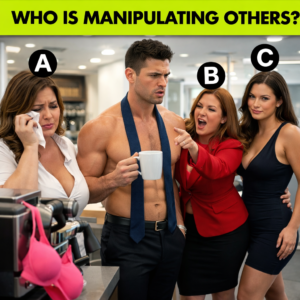
Take a look at the image provided. We are in a bright, modern kitchen. A shattered jar of money lies on the floor, and a shirtless man is demanding answers.
Three women stand before him, each presenting a different reaction to the interrogation. At first glance, none of them seem to be holding the stolen cash.
However, absence of evidence is not evidence of innocence. To find the culprit, we must analyze the biological reality of their emotional displays. We must look for the “incongruence” between their posture and the situation.
The Baseline of Genuine Shock
Let’s begin by analyzing Suspect A on the left. She is displaying a textbook example of genuine surprise. Her hands have flown up to cover her mouth, and she is gasping.
- The Micro-Expression: True surprise is the shortest of all human emotions. It flashes across the face in less than a second before transitioning into fear, anger, or relief.
- The Jaw Drop: When we are genuinely shocked, the muscles in our face relax, causing the jaw to drop and the mouth to open.
- Unfiltered Reaction: Suspect A’s reaction is explosive and uncalculated. She has not had time to think about how she looks; she is simply reacting to the broken glass.
This unfiltered physical response is the hallmark of true innocence. She is experiencing the event at the exact same time the accuser is.
The Anger of the Falsely Accused
Now consider Suspect B in the center. She is not shocked; she is angry. She is pointing an accusatory finger directly at someone else.
Many people mistake anger for guilt, assuming that a defensive person must be hiding something. However, in psychology, righteous indignation is a very common response to being falsely accused.
When an innocent person is interrogated, their sense of justice is violated. They do not cower; they fight back. Suspect B’s outward focus and aggressive posture suggest she has nothing to hide.
The Performance of the Guilty
When someone is guilty, their primary goal is self-preservation. They know they have done wrong, and they anticipate the impending conflict.
Because they are expecting the accusation, they cannot produce genuine surprise. Instead, they must manufacture a reaction that they believe will keep them safe. They try to look as harmless as possible.
This leads to the “overcompensation” of innocence. They use exaggerated facial expressions and submissive body language to manipulate the empathy of the accuser. They want to trigger the accuser’s protective instincts rather than their anger.
The Evolutionary Urge to Hide
The most telling sign of a guilty conscience often happens below the neck. When humans feel threatened or deceitful, the brain’s “freeze” response is activated.
Part of this freeze response involves securing the body’s extremities. The brain subconsciously commands the hands to retreat. This is an evolutionary mechanism designed to conceal weapons or stolen goods.
Even if the hands are completely empty, a guilty person will often tuck them into their pockets, sit on them, or clasp them tightly behind their back. It is a biological attempt to erase themselves from the scene of the crime.
The Solution to the Puzzle
Have you identified the person pretending to be innocent? It is Suspect C (The Woman on the Right). She is the one responsible for the broken jar.
Here is the evidence that exposes her fake innocence:
- Hiding the Hands: Her hands are clasped firmly behind her back. This is a massive psychological tell. She is subconsciously hiding the “instruments of the crime” from the interrogator.
- The “Puppy Dog” Eyes: She is looking up with exaggerated, wide eyes. This is a conscious manipulation tactic. True shock is instantaneous; holding a prolonged, cute expression is a calculated performance.
- Lip Biting: She is biting her bottom lip. This is a pacifying behavior that indicates severe anxiety. She is physically blocking her own mouth to prevent a confession from slipping out.
Suspect A is genuinely shocked. Suspect B is righteously angry. Suspect C is putting on a theatrical performance to save herself.
Why Deception Detection Matters
Learning to spot fake innocence is an invaluable tool for your professional development. In the workplace, toxic employees often use this exact tactic when caught in a mistake.
They will feign ignorance, bat their eyes, and play the victim to avoid accountability. By recognizing the physical signs of concealment (like hiding hands), you can hold them to a higher standard.
This skill also applies to online strategy and remote team management. Even on a video call, you can spot when an employee suddenly shrinks back, touches their face, or tightens their lips when a specific project is mentioned.
Protecting Your Decisions
When making a crucial financial decision, you must separate the performance from the reality. A scammer will often act incredibly submissive and innocent to gain your trust.
They will try to make you feel like the “hero” who is helping them out. If you notice them exhibiting pacifying behaviors or incongruent body language, pause the transaction immediately.
Trust your gut. Your subconscious mind is excellent at picking up on these micro-expressions, even if your conscious mind is distracted by their charming words.
What Your Results Say About You
If you spotted Suspect C immediately, you have a high level of critical observation. You do not fall for emotional manipulation easily. You look past the cute facade and analyze the structural reality of a person’s posture.
If you suspected the angry woman (Suspect B), you might be conflict-averse. You naturally assume that the person making the most noise is the one causing the problem. Remember, the quietest person in the room often has the most to hide.
Keep honing your psychological radar. The better you understand the silent language of the body, the harder it will be for anyone to pull the wool over your eyes.
Enjoyed this challenge?
Try
this tricky behavior puzzle
to test your observation skills.