The Psychology of Secrets: How the Body Reveals What the Mind Hides
We often think of secrets as abstract things—information stored in the cloud or whispers in a dark room. But in reality, a secret is a physical weight. Keeping a secret requires constant, active cognitive effort. You have to monitor everything you say, filter your reactions, and suppress your natural impulses to share. This creates a state of “cognitive load” that the human body is simply not designed to handle for long periods. Eventually, the pressure builds, and the secret tries to escape.
This escape happens through what psychologists call “leakage.” It’s the subtle, often unconscious behaviors that signal a person is withholding information. The mistake in our puzzle isn’t a slip of the tongue; it’s a slip of the hand. It captures the exact moment where the burden of the secret overrides the person’s ability to act normal. While everyone else is relaxed, the secret-keeper is fighting a silent war with their own biology.
The Physiology of Suppression
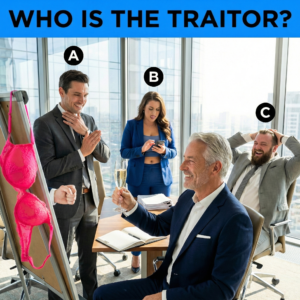
Take a look at the image provided. We are backstage, a place of intimacy and gossip. The man in the center is signaling silence—the universal “Shhh.” But look at the three women around him. On the surface, they all seem to be part of his inner circle. They are comfortable, undressed, and relaxed. But if you zoom in on their body language, you will see a stark difference in how they are reacting to his gesture.
When we are ignorant of a secret, our bodies are “open.” We have nothing to hide, so we don’t feel the need to protect ourselves. We engage in grooming behaviors (like applying makeup) or relaxation behaviors (like checking a phone). But when we know something we shouldn’t, our bodies go into “guard mode.” We might freeze. We might cover our vital organs. We might literally try to stop the words from coming out of our mouths.
This is because keeping a secret triggers the brain’s “inhibition system.” It takes energy to not do something. Think of it like holding a beach ball underwater. As long as you are focused, you can keep it down. But the moment you get distracted or emotional, the ball pops up. In this puzzle, the “ball” is the secret, and the “pop” is the gesture that gives the game away.
The Three Archetypes of Knowledge
Let’s analyze the suspects to see who is hiding what.
The Innocent (Suspect A): She is focused entirely on herself. Applying lipstick requires a steady hand and concentration. A person who is anxious about a secret rarely has the fine motor control for this. She is “self-soothing” through grooming, but her attention is inward, not on the secret.
The Apathetic (Suspect C): She is disengaged. Her body is relaxed, her feet are up (a sign of dominance and comfort), and she is absorbed in her phone. Secrets are exciting; they trigger arousal. If she knew, she would be looking at the man, not her screen. Her indifference is genuine.
The Anxious (Suspect B): She is the only one looking directly at the man. She is the only one displaying “blocking behaviors.” While the others are open, she is closed off. Her body is reacting to the threat of the secret being revealed.
The Hand-to-Mouth Gesture
Why do we cover our mouths when we are shocked or hiding something? It is a primitive, evolutionary response. As children, when we tell a lie or say a bad word, we instinctively slap our hands over our mouths to “catch” the words. As adults, we refine this gesture—maybe we just touch our lips or rub our nose—but in moments of high stress, the original gesture returns. It is the brain’s physical attempt to block the flow of information.
This is often accompanied by the “Freeze Response.” When we sense danger (and getting caught with a secret is a danger), our limbic system tells us to stop moving. We become statue-like. We might grip a chair or our own legs to “ground” ourselves. This rigidity stands out in a room full of moving, relaxed people.
The Solution to the Puzzle
Have you identified the secret-keeper? It is Suspect B (The Woman in the Center). She is the only one who knows the secret.
There are three critical clues that give her away:
- The Mouth Block: Her hand is actively covering her mouth. This is the “leakage.” She is subconsciously preventing herself from speaking. It creates a physical barrier between her truth and the outside world. It is the visual equivalent of biting your tongue.
- The Leg Grip: Look at her other hand. It is gripping her thigh tightly. This is a “pacifying behavior” designed to release nervous energy. It also serves to “freeze” her in place, preventing her from fleeing the situation.
- The Eyes: While her mouth is covered, her eyes are wide. This is a sign of heightened physiological arousal. She is stimulated by the secret—whether it’s fear, excitement, or guilt. Suspects A and C have relaxed, neutral eyes because they simply don’t know enough to care.
Suspect B is physically struggling to contain the information, while the others are blissfully unaware.
Why This Skill Matters
Spotting who knows a secret is a powerful tool in negotiation strategy and leadership. In a business meeting, there is often information asymmetry—one side knows something the other doesn’t (like a pending lawsuit or a better offer). By watching who touches their lips, who freezes, or who suddenly becomes rigid when a specific topic is raised, you can identify the weak link in their team.
This skill also applies to conflict resolution in personal relationships. If you ask a question and someone immediately covers their mouth or rubs their nose, it’s a red flag. It doesn’t prove they are lying, but it proves they are having a stress reaction to the question. It tells you where to dig deeper.
Furthermore, understanding “cognitive load” helps in personal development. If you are keeping secrets, you are draining your own mental battery. You are making yourself less effective at decision-making and more prone to anxiety. Recognizing these signs in yourself can be a wake-up call to practice radical honesty and relieve the burden.
What This Says About You
If you spotted Suspect B immediately, you are likely highly attuned to “emotional leakage.” You notice the small cracks in people’s armor. You are the friend who asks, “Is everything okay?” when everyone else thinks things are fine. In your career, this makes you excellent at risk assessment and human resources.
If you focused on the man or the decoy object, you might be easily distracted by “the show.” Secrets are often hidden in plain sight, masked by spectacle. Learning to look past the main attraction and focus on the audience reaction is a key digital skill for navigating the modern world of misinformation.
The lesson here is that the body rarely lies. The mind can construct elaborate fictions, but the hands will always try to catch the truth before it falls.
Enjoyed this challenge?
Try our
another brain challenge
to test your observation skills.