The Psychology of Focus: Training Your Brain to Spot Details in the Chaos
A modern gym is a sensory overload. The clanging of weights, the rhythmic thud of treadmills, loud music, and people moving in every direction create a chaotic environment. It is a place designed for physical exertion, but it is also a fantastic testing ground for your mental focus. In such a busy setting, your brain has to work overtime to filter out the noise and zero in on what’s important—your form, your count, your breathing.
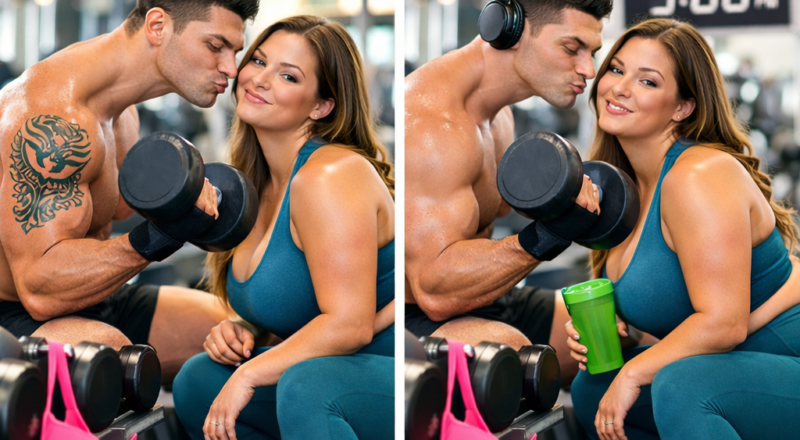
This “Spot the Difference” puzzle transports you right into the middle of a high-energy workout session. The scene is bright, busy, and full of life. At first glance, the two images seem to capture the exact same moment of effort and strength. But, like a muscle that needs to be challenged to grow, your powers of observation will need to stretch to find the five subtle alterations hidden within these frames.
The Challenge: Finding Clarity in the Commotion
Take a look at the two images provided. You’ll see a dedicated duo pushing through their routine. The energy is high, the sweat is real, and the setting is authentic right down to the equipment racks in the background. Your brain, wanting to be efficient, will quickly label this scene: “Gym Workout.” Once it has that label, it stops looking closely at the individual components. Why bother noting the color of shoes or the presence of a water bottle if the overall picture is clear?
This is the cognitive shortcut we are fighting against. To solve this puzzle, you must override that autopilot function. You need to switch from a passive “wide-angle” view to an active “zoom-lens” approach. You must systematically scan the image, treating every object—from the heaviest dumbbell to the smallest accessory—as a potential suspect. The differences aren’t hiding in shadows; they are hiding in plain sight, camouflaged by the busyness of the environment.
The decoy object—the bright neon pink item—is placed in the foreground to deliberately pull your eye. It’s unusual and vibrant, acting as a visual magnet. While your attention is stuck on the decoy, your brain is less likely to notice a change in a more common object, like a pair of headphones or a clock on the wall. This is a classic example of how misdirection works, both in puzzles and in real life.
Understanding “Selective Attention”
Why do some details jump out while others remain invisible? This is due to a psychological process called “Selective Attention.” Think of your attention like a spotlight on a dark stage. You can only shine that light on one small area at a time. Everything outside the spotlight is dim and unfocused. When you look at the man curling the weight, your spotlight is on his arm. You might completely miss what is happening on the other side of the frame with the woman.
In our daily lives, this spotlight is often guided by our expectations. We expect to see weights in a gym, so we don’t scrutinize them. We don’t necessarily expect to see a specific tattoo or a particular color of shoe, so those details fall outside our attentional spotlight until we consciously move it there. Mastering this puzzle is about taking manual control of that spotlight and sweeping it across the entire stage, leaving no corner unlit.
Developing this kind of disciplined focus is essential for career growth. Whether you are analyzing complex data sets for a financial decision, proofreading important documents, or managing a multi-faceted project, the ability to direct your attention where it’s needed most—and keep it there without getting distracted by the “noise”—is a hallmark of high performance.
Strategies for Visual Success
To beat the puzzle, try the “Object Isolation” technique. Instead of looking at the whole image, pick one category of object at a time. First, look only at clothing. Compare the woman’s outfit in both pictures, then the man’s. Next, look only at equipment. Check the weights, the bench, the racks. Finally, check the people themselves—their hair, arms, and faces. By narrowing the category, you make the task manageable.
This methodical approach is a powerful digital skill. In an online world filled with endless distractions, tabs, and notifications, being able to isolate a single task and complete it with precision is a superpower. It’s the difference between busy-work and deep, productive work.
The Solution to the Puzzle
Have you found all five? If the sweat is getting in your eyes, here is the breakdown of what changed between the two workout sessions:
First, check the Man on the left. In the Left image, he has a large tribal Tattoo on his right bicep. In the Right image, his arm is completely bare.
Next, look at his head. In the Right image, he is wearing large, black over-ear Headphones to stay in the zone. In the Left image, he is working out without them.
Now, move over to the Woman on the right. Look at her feet. In the Left image, her athletic sneakers are a vibrant Blue. In the Right image, she is wearing standard White trainers.
Check her hands. In the Right image, she is holding a green Shaker Bottle, likely for post-workout protein. In the Left image, her hand is empty as she performs the squat.
Finally, scan the background wall behind them. In the Right image, a large digital wall Clock has appeared, showing the time as “5:00 PM”. In the Left image, the wall is blank.
Why This Skill Matters
Improving your visual attention isn’t just about being good at puzzles. It has real-world applications. In professional development, it translates to better situational awareness. You become the person who notices the non-verbal cues in a meeting, the small print in a contract, or the early warning signs of a problem before it becomes a crisis.
This skill also enhances your memory. By actively engaging with details, you encode them more deeply into your brain. You’ll find yourself remembering names, faces, and facts with greater ease because you actually saw them in the first place, rather than just glancing over them.
Moreover, the act of focusing intensely on a visual task can be a form of mindfulness. It pulls you out of your looping thoughts and grounds you in the present moment, much like a good workout grounds you in your body.
What This Says About You
If you found the headphones and the shaker bottle first, you are likely a “practical observer.” You notice objects related to function and utility. You are probably good at logistics and organizing resources.
If you noticed the tattoo or the shoe color first, you might be more “aesthetically driven.” You pay attention to personal style and visual identifiers. This makes you good at branding, design, or reading personal expression.
Regardless of your order, completing the puzzle shows you have mental stamina. You don’t give up when the answer isn’t immediately obvious. You keep pushing, just like that last rep in the gym.
Enjoyed this challenge?
Try
this tricky puzzle
to test your observation skills.