The Psychology of Fear: Why We Miss Details in the Dark
Fear is one of the most powerful emotions the human brain can experience. It is a primal survival mechanism designed to keep us alive in the face of danger. When we are scared, our senses sharpen, our heart rate spikes, and our adrenaline surges. But ironically, while fear heightens our awareness of threats, it can actually blind us to the details. This phenomenon is known as “perceptual narrowing” or tunnel vision. When the brain is focused on a potential monster, it stops processing the non-threatening elements of the scene.
This “Spot the Difference” puzzle plays with that instinct. It places you in a spooky, atmospheric setting—a haunted house at night. The visual cues of danger (darkness, fog, terrified expressions) trigger a low-level anxiety response in your brain. Your eyes want to dart around looking for the threat, making it much harder to calmly analyze the image for subtle changes. Can you overcome your instincts and find the differences hidden in the shadows?
The Challenge: Ghosts in the Machine
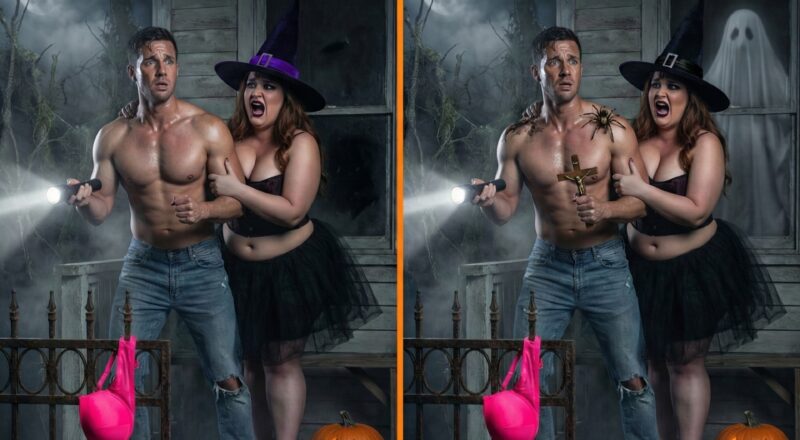
Take a look at the two images provided. They capture a classic horror movie moment: a couple investigating a strange noise on the porch of an abandoned mansion. The lighting is dim, the mood is tense, and the characters are clearly distressed. It’s a scene designed to make you uneasy. But remember, this is just a puzzle. The “danger” is an illusion created by pixels and composition.
To solve it, you need to detach yourself from the narrative. Don’t look at the “scared couple”; look at the shapes and colors. Compare the man’s silhouette in Image A to Image B. Check the woman’s costume. Scan the background elements like the window and the pumpkin. The artist has altered five specific details. Some are classic horror tropes (like a ghost), while others are simple color swaps that defy the spooky atmosphere.
The decoy object—the bright neon pink item—is particularly effective here because it clashes so violently with the dark, desaturated palette of the rest of the image. In a dark room, our eyes are naturally drawn to the brightest light source or color. By placing a neon object in the foreground, the puzzle designers are hacking your visual hierarchy, forcing you to look away from the shadows where the real changes are hiding.
Understanding “Inattentional Blindness”
Why do we miss things right in front of us? This is often due to “Inattentional Blindness.” This occurs when an individual fails to perceive an unexpected stimulus that is in plain sight. A famous study showed that people counting basketball passes completely missed a person in a gorilla suit walking through the scene. In this puzzle, you are “counting passes” (looking for differences), but the eerie atmosphere adds a layer of cognitive load.
When your brain is stressed or “spooked,” it allocates resources to the biggest threats first. It prioritizes movement and faces. It de-prioritizes static objects like a hat ribbon or a pumpkin carving. This is why witnesses to crimes often remember the gun (the threat) vividly but cannot recall what the perpetrator was wearing. Training your brain to override this instinct is a key part of situational awareness.
This skill is incredibly valuable for decision making in high-pressure environments. Whether you are a first responder, a stock trader making a split-second financial decision, or a parent navigating a chaotic playground, the ability to see the whole picture—not just the scary parts—is crucial. It prevents you from reacting to false alarms and helps you identify the real issues.
Strategies for Visual Success
To beat the puzzle, try the “Background-Foreground Sweep.” Start by ignoring the people entirely. Scan the background of Image A and compare it to Image B. Look at the windows, the walls, and the floor. Once you have cleared the environment, move to the characters. Check their heads, then their torsos, then their hands.
This systematic approach helps you avoid the “emotional hook” of the characters’ faces. Humans are hardwired to look at faces first. By consciously choosing to look at the background, you bypass that biological programming. This kind of disciplined observation is essential for career growth in analytical fields. It shows you can control your focus and direct your attention where it is needed most, rather than just reacting to whatever is loudest or brightest.
The Solution to the Puzzle
Have you found all five? If the shadows are playing tricks on you, here is the reveal:
First, look at the window behind the couple. In the Right image, a translucent white Ghost has appeared in the glass. In the Left image, the window is dark and empty.
Next, check the porch step. There is a carved Pumpkin sitting there. In the Left image, it has a sad, Scary face. In the Right image, it has been swapped for a cheerful, Happy jack-o’-lantern.
Now, look at the Man’s hands. In the Right image, he is clutching a wooden Crucifix for protection. In the Left image, his hand is empty and clenched in a fist.
Move to the Woman’s costume. Specifically, look at her witch hat. In the Left image, the ribbon band around the hat is a vibrant Purple. In the Right image, it is a standard Black.
Finally, check the Man’s shoulder. In the Right image, a large, creepy Spider is crawling on his skin. In the Left image, his shoulder is bare.
Why This Skill Matters
Practicing observation in “scary” or high-stress contexts builds mental resilience. It teaches you to remain calm and analytical even when the visual data is unsettling. This is a core component of emotional intelligence and professional development. Being the person who keeps their head when everyone else is losing theirs is the definition of leadership.
In your online strategy, this skill translates to being able to spot threats and opportunities in a chaotic market. Just as you learned to look past the ghost to see the pumpkin, you can learn to look past market volatility to see the underlying trends.
Moreover, these puzzles are fun! They give you a safe space to experience a little thrill while exercising your brain. The dopamine hit you get from finding that last difference is a great mood booster and stress reliever.
What This Says About You
If you found the ghost and the spider first, you are likely “threat-sensitive.” You prioritize safety and are quick to spot potential dangers. This makes you excellent at risk management and security.
If you noticed the pumpkin or the ribbon first, you are likely more “detail-oriented.” You look for patterns and inconsistencies in the environment rather than reacting to emotional triggers. This makes you a great planner and organizer.
No matter which you found, you proved that you can stare into the darkness and see the light (and the differences). That is a brave thing indeed.
Enjoyed this challenge?
Try
this spooky visual puzzle
to test your observation skills.