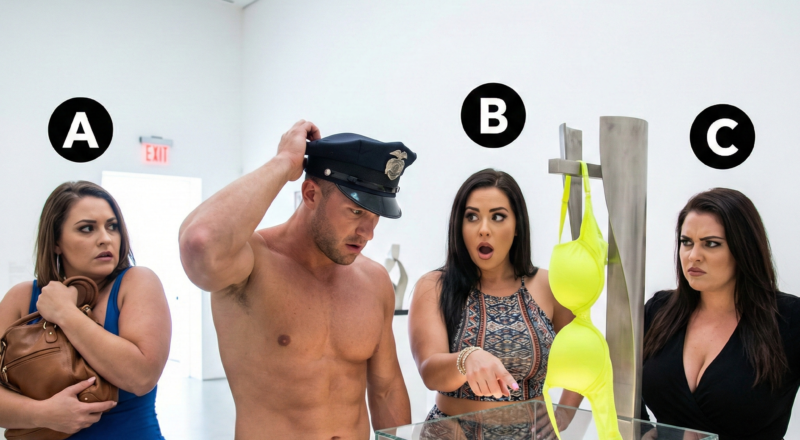
In the high-stakes world of museum security and inventory management, the moments immediately following a theft are critical. Professional “Loss Prevention” experts know that the thief is rarely the person running away; they are usually the person trying to blend in while planning their exit. This is known as the “Flight Suppression” response. While innocent bystanders focus on the event (the missing item), the perpetrator focuses on the environment (the escape route).
In this viral psychology test, we present a crime scene in a gallery. A high-value asset has been removed. Three female subjects are present. The objective is to identify the “Security Threat” (The Thief) by analyzing their visual fixation and body language.
The Decoy: The “Visual Anomaly”
Your attention was likely immediately hijacked by the Neon Pink Bra hanging on the sculpture. In risk assessment, this is a “Distraction Event.” Sophisticated thieves often create a chaotic visual or social scene to confuse security personnel.
Why is it there? It tests your “Investigative Discipline.” If you are staring at the neon object, you are failing to monitor the perimeter. The thief relies on you being confused by the absurdity so they can slip away unnoticed. To solve the crime, you must ignore the art and watch the people.
Analyzing Suspect B: The “Shock Response”
Let’s audit the subject in the center (labeled B), with the visible midriff. She is pointing at the empty case with her mouth open.
In human psychology, this is the “Orienting Reflex.” When something changes in our environment (like an object disappearing), our brain forces us to stare at the anomaly to process the data. Her focus is entirely on the “Void”—the place where the object used to be. This is the behavior of an innocent witness trying to understand what happened.
Analyzing Suspect C: The “Liability Assessment”
Now, look at the subject on the right (labeled C), with visible cleavage. She is staring at the security guard with her hands on her hips.
In conflict resolution, this is “Blame Assignment.” She has moved past the shock of the theft and is now focused on the failure of the system. She is judging the guard for his negligence. While she is aggressive, she is not the thief. A thief avoids looking at security personnel to avoid drawing attention to themselves.
Analyzing Suspect A: The “Flight Risk”
Finally, we examine the subject on the left (labeled A), the big voluptuous woman in the blue dress.
1. The Eye Tracking: Look at her eyes. Everyone else is looking at the case or the guard. She is looking to the **Right**—specifically at the exit sign. In criminal profiling, this is “Targeting the Exit.” Her brain is calculating the path to safety.
2. The Clutch: She is holding her purse tightly against her chest with both hands. This is “Resource Guarding.” She is creating a physical barrier around the stolen asset.
The Verdict: Suspect A is the Thief. She is physically protecting the loot and visually planning her escape.
Conclusion: The Eyes Reveal the Exit
The innocent look at the crime. The guilty look at the door. If you spotted the woman ignoring the empty case, you just recovered the diamond.
Scroll back up to the video. Ignore the pointing finger. Follow the eyes of the quiet one. She is already halfway out the door.
