The Garlic Effect: Why “Fitting In” is the Enemy of True Belonging
We live in a world that is obsessed with metrics, appearances, and checking boxes. We are taught from a young age to mold ourselves to meet specific criteria. We tailor our resumes to match job descriptions, we dress to match the dress code, and we adjust our vocabulary to match our peer groups. We become experts at shapeshifting.
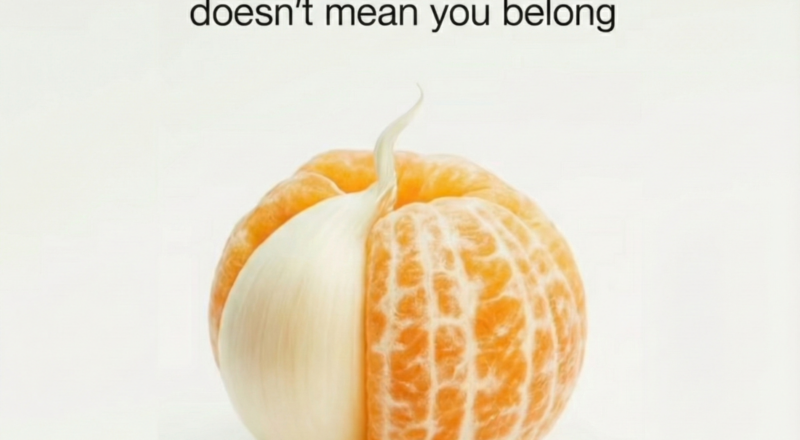
But there is a profound difference between molding yourself to fill a space and actually being made for that space. A viral image circulating recently captures this struggle perfectly: a peeled tangerine with one missing segment replaced by a perfectly shaped clove of garlic. The caption reads: “Just because you fit, doesn’t mean you belong.”
This simple visual metaphor carries a heavy psychological weight. It speaks to the loneliness of the “imposter,” the exhaustion of high-functioning anxiety, and the distinct difference between adaptation and alignment. In this guide, we are going to explore why we confuse these two concepts and how to find the courage to leave spaces where you fit, so you can find the places where you belong.
The Difference Between Dimensions and DNA
Let’s look at the “Garlic Theory” presented in the image. On a surface level, the garlic clove is a success. If the goal was simply “fill the empty void,” the garlic achieved it. It has the correct dimensions. It creates a complete circle. To a casual observer walking past, nothing looks broken.
However, the essence of the garlic is fundamentally opposed to the essence of the orange. One is savory, pungent, and intense; the other is sweet, acidic, and refreshing. Placing them together doesn’t create fusion; it creates contamination. The garlic will eventually smell like orange, and the orange will taste like garlic. Both lose their integrity.
“Fitting in” is about:
- External metrics: Do I look like them? Do I talk like them?
- Acquiescence: Changing your shape to minimize friction.
- Safety: Avoiding rejection by blending into the background.
“Belonging” is about:
- Internal values: Do we care about the same things?
- Authenticity: Being accepted without having to change your nature.
- Growth: thriving because the environment nourishes you.
The Corporate Trap: The Qualified Misfit
One of the most common places Americans experience the “Garlic Effect” is in the workplace. We have all been there—or we know someone who has.
Imagine you land a high-paying job at a prestigious finance firm. On paper, you are the perfect candidate. You have the MBA, you have the analytical skills, and you know how to wear the suit. You fit the slot. You are plugging the hole in their org chart perfectly.
But perhaps your core nature is creative, empathetic, and collaborative, while the company culture is cutthroat, siloed, and purely data-driven. Every day you go to work, you have to “act” the part. You can do the work (you fit), but the work drains your soul (you don’t belong).
Signs You Are “Garlic” in a Fruit Company:
- Chronic Exhaustion: Not from the workload, but from the effort of maintaining a persona.
- Code Switching: You feel like you become a completely different person the moment you walk through the office doors.
- Value Clashes: When the company wins, you don’t feel excited; you feel indifferent or even conflicted.
- Invisibility: You feel that if you actually spoke your mind, you would be fired or ostracized.
When you stay in these roles, you aren’t just hurting yourself; you are actually hurting the team. Just as a bite of garlic ruins the fruit salad, an unaligned employee can create subtle friction in a team, not because they are “bad,” but because they are operating on a different frequency.
Social Circles and The Fear of Being Alone
Why do we force ourselves into spaces where we don’t belong? The answer is usually rooted in our evolutionary history. For early humans, being cast out of the tribe meant death. We are hardwired to seek entry into the group at all costs.
This leads us to maintain friendships that have expired or join social circles that don’t respect us, simply because we fit the demographic. You might hang out with the “soccer moms” or the “golf guys” because you play those sports and live in that neighborhood. But if you leave those gatherings feeling empty, judged, or unseen, you are experiencing the difference between fitting and belonging.
Dr. Brené Brown, a leading researcher on vulnerability, famously said: “Fitting in is the greatest barrier to belonging. Fitting in is assessing a situation and becoming who you need to be to be accepted. Belonging, on the other hand, doesn’t require us to change who we are; it requires us to be who we are.”
The Dangers of Forced Fitting
When you spend years playing the role of the garlic clove inside the orange, there are real-world consequences.
1. The Loss of Self-Identity
If you spend 40 hours a week pretending to be an orange, you eventually forget that you are garlic. You lose touch with your unique strengths. Garlic is amazing—it is the base of flavor for cuisines around the world! But if garlic tries to be a dessert, it fails. When you force a fit, you devalue your natural talents because they aren’t being used in the right context.
2. Cognitive Dissonance
Living a life that contradicts your internal values creates a psychological state called cognitive dissonance. This is a mental conflict that occurs when your beliefs don’t match your behaviors. This leads to anxiety, depression, and a lingering sense of “fraudulence” or Imposter Syndrome.
3. Opportunity Cost
Every day you spend occupying a space where you don’t belong is a day you are not available for the space where you do belong. Somewhere out there is a savory pasta sauce that is desperately missing a clove of garlic. But the garlic is too busy pretending to be a fruit to find its true home.
How to Stop Fitting and Start Belonging
Transitioning from a life of “fitting in” to a life of belonging is scary. It requires you to step out of the gap you’ve comfortably filled and risk being exposed. Here is how to start that journey.
Step 1: The Taste Test (Audit Your Life)
Look at the major areas of your life: Career, Relationship, Community, Hobbies. Ask yourself the hard questions:
- “Do I feel energized after spending time here, or drained?”
- “Do I have to suppress my opinions to keep the peace?”
- “If I showed my true self—my weirdness, my fears, my dreams—would I still be welcome here?”
If the answer to the last question is “no,” you are merely fitting in.
Step 2: Accept Your “Garlic” Nature
Stop wishing you were an orange. Stop wishing you were more analytical, more extroverted, taller, or quieter. Radical self-acceptance is the foundation of belonging. Identify what makes you “spicy” or distinct. What is the thing about you that doesn’t fit? That is usually your superpower.
Step 3: Endure the Wilderness
Leaving a place where you fit usually leads to a period of solitude. This is the “wilderness.” It is better to be alone and authentic than surrounded and fake. Use this time to recalibrate your compass. Look for environments that value what you naturally provide.
Step 4: Find Your Tribe
You will know you have found where you belong when:
- Silence isn’t awkward.
- You are celebrated, not just tolerated.
- Your growth is encouraged, even if it disrupts the status quo.
- You feel a sense of “exhale”—you can finally stop holding your breath and sucking in your stomach.
Conclusion: The Takeaway
The image of the garlic in the orange is funny, but it is also a warning. It reminds us that appearance is not reality. You can have the title, the house, the ring, and the crew, and still feel completely out of place.
Don’t waste your life acting. If you are garlic, go find the pasta, the stir-fry, or the roasted chicken. Go where your flavor is celebrated. It requires bravery to walk away from a perfect fit, but it is the only way to find where you truly belong.
Remember: The goal of life isn’t to fill a gap. The goal is to fulfill your purpose.
