The Mirror Effect: Why Your Children Copy Everything You Do (And How to Lead by Example)
There is an old saying that every parent knows, yet frequently forgets in the heat of the moment: “Actions speak louder than words.” Nowhere is this truer than in the psychological development of a child. We often think of parenting as a series of lectures, rules, and verbal guidance. We tell our kids to say “please,” to share their toys, and to be kind to others. But science and psychology tell us a different story.
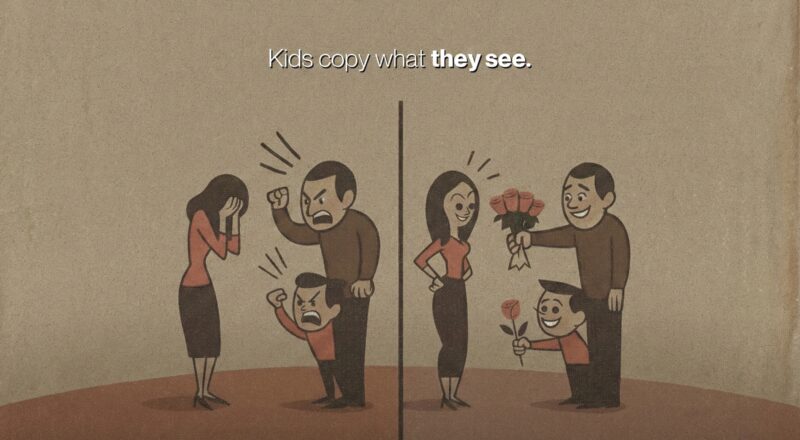
As illustrated by the profound image of the split-screen family, children are not just listeners; they are aggressive observers. They are constantly recording our behaviors, our tones of voice, and our reactions to stress, storing them away to build their own personality toolkit. This phenomenon, often called observational learning, is the most powerful force in parenting. Today, we are going to dive deep into why kids copy what they see, the dangers of toxic modeling, and how you can harness this power to raise empathetic, emotionally intelligent children.
The Science of “Monkey See, Monkey Do”
The concept shown in the illustration—a child mimicking his father’s aggression on one side and his affection on the other—is rooted in established psychological theory. In the 1960s, psychologist Albert Bandura conducted the famous “Bobo Doll Experiment.” He found that children who watched adults treat a doll aggressively were far more likely to treat the doll the same way. They didn’t just copy the physical hitting; they copied the anger.
Biologically, this is often linked to “mirror neurons” in the brain. These are neurons that fire both when we act and when we observe the same action performed by someone else. When a child sees a parent yelling, their brain rehearses that action neurally. Over time, these rehearsals become habits.
The Cycle of Toxicity: When Anger Becomes Inherited
Let’s look at the left side of the image. It represents a reality that is all too common. The father is venting his frustration on the mother. He is yelling, his body language is closed and aggressive. The tragedy isn’t just the conflict between the adults; it is the little boy standing in the shadow.
The boy isn’t frightened into silence; he is emboldened into imitation. He sees the most powerful person in his life—his father—handling conflict with aggression. To a child’s developing brain, this sends a clear message:
- Conflict Resolution: “This is how we solve problems. We get loud.”
- Power Dynamics: “To be strong means to dominate others.”
- Emotional Regulation: “It is okay to explode when I am mad.”
This is how generational trauma is passed down. It is rarely genetic; it is learned behavior. If a child grows up seeing that love is volatile and that anger is the default reaction to stress, they will carry that blueprint into their own future relationships. They copy the dysfunction because it is the only “normal” they have ever seen.
The Cycle of Love: Cultivating Empathy Through Action
Now, let’s embrace the hope on the right side of the image. Here, the narrative flips. The father is smiling, his body language is open, and he is offering a gesture of love (flowers) to the mother. The atmosphere is light, respectful, and safe.
Look at the boy now. He isn’t cowering, and he isn’t raging. He is holding a small flower, looking up with a smile. He is practicing kindness. By witnessing his father treat his mother with respect, the child learns:
- Empathy: “I should care about how other people feel.”
- Security: “My home is a safe place where people are kind to each other.”
- Romance and Respect: “This is what love looks like.”
This child is likely to grow up with higher emotional intelligence. He learns that strength isn’t about volume or force; it’s about control, kindness, and generosity. This is the “positive cycle” of parenting.
Practical Steps to Be the Role Model Your Child Needs
Recognizing that “kids copy what they see” can feel like a lot of pressure. It means we have to be “on” all the time, right? Not necessarily. It doesn’t mean you have to be perfect, but it does mean you have to be conscious. Here are practical ways to ensure you are modeling the behavior you want to see in your children.
1. Manage Your Stress Out Loud
Kids will see you get angry. That is inevitable. The lesson is in how you handle it. Instead of yelling when you drop a plate or get cut off in traffic, try to verbalize your coping mechanism.
- Instead of screaming: Say, “Wow, I am really frustrated right now. I’m going to take three deep breaths before I say anything else.”
- Why it works: You are teaching them a script for handling their own big feelings.
2. Apologize When You Mess Up
If you do lose your temper (as represented on the left side of the image), do not pretend it didn’t happen. Repair the rupture.
- The Action: Sit down with your child and say, “I lost my temper earlier, and I shouldn’t have yelled. I was feeling overwhelmed, but it’s not okay to shout. I am sorry.”
- The Lesson: This teaches accountability. It shows them that even adults make mistakes and that apologizing is a sign of strength, not weakness.
3. Treat Your Partner with Visible Respect
Your relationship with your spouse or co-parent is the primary example of a relationship your child has. Even if you are separated, how you speak about or to the other parent matters.
- Listen without interrupting: Show that others deserve to be heard.
- Show affection: Small gestures like holding hands or saying “thank you” for dinner teach the language of love.
- Disagree respectfully: It is okay to argue, but do it without insults or aggression.
The Takeaway
The image of the father and son is a mirror for all of us. It asks a difficult question: If your child acted exactly like you today, would you be proud?
Children are our greatest imitators. They will follow us into the dark, or they will follow us into the light. The choice of which path to take is made in the small, everyday moments of our lives. Choose kindness. Choose patience. Choose love. Because they are watching, and they are copying.
