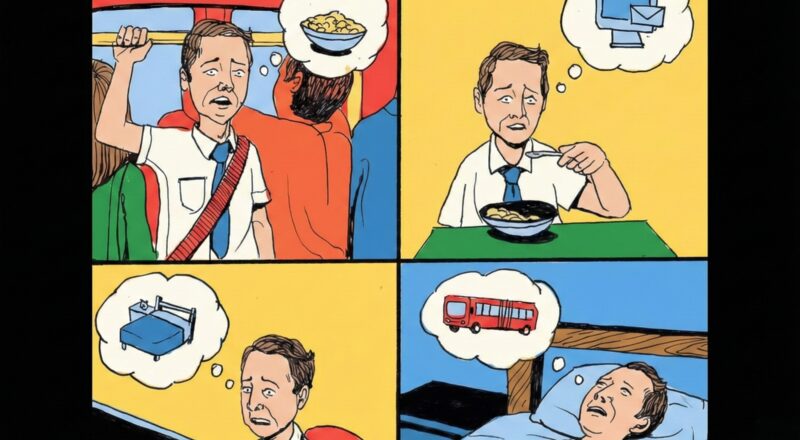
There is a four-panel comic strip circulating the internet that perfectly captures the modern human condition. It doesn’t feature superheroes or political jokes. Instead, it features a tired-looking man simply living his day. Yet, for many of us, it is the most terrifying horror story we have ever seen.
The image depicts a cycle we all know too well: The body is present, but the mind is absent. We are constantly time-traveling to the future, hoping that the next moment will be better than the current one. But when that next moment arrives, we move the goalposts again.
This article explores the psychology behind this cycle, why we fall into it, and how to break free before we miss out on our lives entirely.
The Anatomy of the Cycle
Let’s break down the image, panel by panel, to understand the trap the main character—and likely you—are stuck in.
- The Commute: In the first panel, the man is on a crowded bus. It’s uncomfortable. Naturally, his mind escapes to a place of comfort: food. He thinks, “If I can just get through this commute, I can relax with a meal.”
- The Meal: In the second panel, he has the food he desired. But look at his face. He looks anxious. Why? Because he isn’t tasting the food. He is thinking about the unread emails and the work waiting for him on his computer.
- The Grind: In the third panel, he is doing the work. But he isn’t focused or productive. He is exhausted, dreaming of his bed. “If I can just finish this shift,” he tells himself, “I can finally sleep.”
- The Rest: The final panel is the most tragic. He is finally in the bed he dreamed of all day. But instead of sleeping, he is awake, staring at the ceiling, dreading the bus ride the next morning.
The circle is complete. He has spent 24 hours chasing the future, never once inhabiting the present.
Understanding “Destination Addiction”
Psychologists and philosophers often refer to this state as “Destination Addiction.” It is the preoccupation with the idea that happiness is in the next place, the next job, or with the next partner. Until you give up the idea that happiness is somewhere else, it will never be where you are.
We live in a culture that rewards “nexting.” We are taught to plan, to strategize, and to prepare. While these are necessary skills for survival, they become toxic when they prevent us from experiencing reality.
The Problem with the “When-Then” Mindset
Many of us operate on a “When-Then” logic:
- “When I get that promotion, then I’ll be happy.”
- “When the weekend comes, then I’ll relax.”
- “When I buy a house, then I’ll feel secure.”
The comic shows us the lie in this logic. The man got the food (the “when”), but he didn’t get the satisfaction (the “then”). He got the bed, but he didn’t get the rest. The external circumstances changed, but his internal state remained anxious and future-focused.
The Cost of Being Absent
What is the actual cost of living like the man in the comic? It goes beyond just feeling a bit stressed.
1. Loss of Sensory Experience
When you eat while thinking about emails, you literally do not taste your food. Your brain processes the calories, but the pleasure center is disconnected. You are consuming, but you aren’t experiencing.
2. Chronic Anxiety
Anxiety is, by definition, living in the future. It is the body reacting to a hypothetical event that hasn’t happened yet. In the fourth panel, the man is suffering the stress of the bus ride while lying in a soft bed. He is suffering twice: once in his imagination, and once when he actually takes the bus.
3. Relationship Erosion
Though not shown in the comic, imagine if this man had a partner or children. If he is physically there but mentally at work, he is emotionally neglecting those around him. You cannot connect with others if you aren’t in the room.
Practical Insights: How to Break the Loop
If you see yourself in this image, don’t panic. Awareness is the first step. You cannot wake up if you don’t realize you are dreaming. Here are practical, actionable steps to stop the cycle.
The “Touch and Taste” Method
When you find yourself in a transition period (like the commute or eating lunch), force your brain to acknowledge sensory data.
- See: Identify three specific colors you can see right now.
- Touch: Feel the texture of your chair or the fabric of your clothes.
- Taste: If you are eating, put the phone down. Chew slowly. Identify the spices.
Compartmentalize Your Worry
In the second panel, the man ruins his dinner by worrying about emails. To combat this, use a “Worry Window.”
Tell yourself: “I will worry about work between 8:00 PM and 8:15 PM. I will not think about it during dinner.” If the thought pops up, write it down and promise your brain you will deal with it at the appointed time.
The Bedtime Reset
The fourth panel is the most common struggle: revenge bedtime procrastination or anxiety loops. To fix this:
- Brain Dump: Keep a notebook by the bed. Write down the tasks for tomorrow. Once they are on paper, your brain has permission to let them go.
- Gratitude: Instead of dreading the bus, force your brain to find one thing that went right today. It shifts the neural pathways from threat detection to safety.
The Lesson: The Power of Now
The sad reality of the comic is that the man is actually safe in three out of the four panels. He has food, he has a job, and he has a bed. His suffering is entirely self-manufactured by his inability to stay present.
Life is not a series of milestones to be crossed off; it is a series of moments to be felt. If you spend your life waiting for the bus to stop, or the workday to end, you will eventually run out of time without ever having really lived.
Conclusion
Look at the comic one last time. The tragedy isn’t that the man has a boring life. The tragedy is that he isn’t attending it.
Don’t let this be your biography. When you eat, just eat. When you walk, just walk. When you sleep, just sleep. It sounds simple, but in our modern world, it is a radical act of self-love.
