The Silent Saboteur: Why You Need to Stop Creating Problems in Your Head
We live in an era of information overload, high-pressure hustle culture, and constant connectivity. In the United States especially, we are conditioned to believe that if we aren’t worrying about something, we aren’t being productive. But sometimes, the most profound advice comes from the simplest places—like a yellow sticky note on a disposable coffee cup.
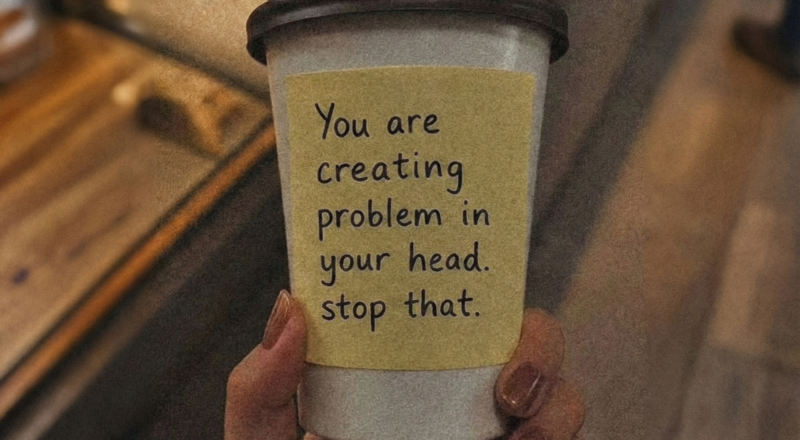
The image is simple: a hand clutching a warm cup of coffee with a handwritten message that reads, “You are creating problem in your head. stop that.”
It is blunt. It is direct. And for many of us, it is entirely necessary. This article dives deep into the psychology of self-sabotage, the American epidemic of overthinking, and practical, actionable ways to mute the noise and reclaim your peace.
The Anatomy of “Head Problems”
Why do we do this? Why do we invent catastrophes that haven’t happened? Psychologists call this “catastrophizing” or “ruminating.” It is a biological evolutionary trait gone wrong. Thousands of years ago, assuming the worst (like a predator in the bushes) kept us alive. Today, that same mechanism is triggered by an unread email or a vague comment from a boss.
When the cup says you are “creating problems,” it refers to the narrative gap. This is the space between reality (what is actually happening) and perception (the story you tell yourself about what is happening).
The Cost of Overthinking
Creating problems in your head isn’t a victimless crime. You are the victim. The costs are tangible:
- Decision Paralysis: You become so afraid of making the wrong move that you make no move at all.
- Physical Burnout: Your brain cannot distinguish between a real threat and an imagined one. Cortisol shoots up regardless, leading to fatigue and inflammation.
- Relationship Strain: You react to things people didn’t say or meanings they didn’t intend.
Breaking the Cycle: The “Coffee Cup” Method
The beauty of the image provided is its setting: a coffee break. It implies a pause. To stop creating problems, you don’t need a PhD in neuroscience; you need a system of pauses.
1. Identify the Fiction
The first step is awareness. You have to catch yourself in the act. When you feel your chest tighten or your mind race, ask yourself one question:
“Is this a problem I have right now, or is this a problem I am imagining I might have later?”
If the problem is in the future, it doesn’t exist yet. You are hallucinating a crisis.
2. The “Stop That” Command
The note on the cup ends with a command: “stop that.” It sounds too simple to work, but cognitive interruption is a powerful tool.
- Visual Anchors: Use physical objects (like your morning coffee) as a trigger to reset your mindset.
- The 5-Second Rule: Popularized by Mel Robbins, count backward 5-4-3-2-1 to interrupt your brain’s habit loop and shift gears physically.
Practical Strategies for Western Lifestyles
In the USA, we often wear stress as a badge of honor. We feel that if we aren’t “creating problems” to solve, we aren’t working hard enough. Here is how to deprogram that mindset.
The “Circle of Control” Exercise
Grab a piece of paper (or a sticky note). Draw a circle. Inside the circle, write what you can control. Outside, write what you cannot.
- Inside the Circle (Focus Here): Your words, your actions, your work ethic, your boundaries.
- Outside the Circle (Let Go): The economy, other people’s opinions, the weather, the past, the distant future.
When you focus on the outside of the circle, you are creating problems in your head. When you focus on the inside, you are solving them in reality.
Sensory Grounding
Anxiety lives in the mind; reality lives in the body. To get out of your head, get into your senses. The person holding the cup in the image feels the heat of the coffee and the texture of the paper. Try the 3-3-3 method:
- Name 3 things you can see.
- Name 3 sounds you can hear.
- Move 3 parts of your body (fingers, toes, shoulders).
Emotional Intelligence: Kindness Over Criticism
The phrase “stop that” can be read aggressively, but let’s read it with love. We are often our own worst bullies. We create problems because we think we need to be prepared for every disaster to be safe.
Forgive yourself for overthinking. It is your brain trying to protect you. But then, firmly tell your brain: “Thank you for the warning, but we are safe. We don’t need to panic.”
Conclusion: Drink the Coffee
Life brings enough real challenges on its own; you do not need to volunteer to manufacture extra ones. The next time you find yourself spiraling, remember the sticky note.
Are you solving a puzzle, or are you just inventing a maze? There is a difference. Put down the heavy load of “what ifs.” Feel the warmth of the cup in your hand. Look at the world in front of you.
Key Takeaway
Your peace is expensive; do not trade it for a worry that doesn’t even exist. Stay in the present, handle reality as it comes, and trust yourself to handle the future when—and if—it arrives.
