The Unseen Burden: Why We Should Stop Judging and Start Understanding
Decoding the Scene: Two Truths, One Situation
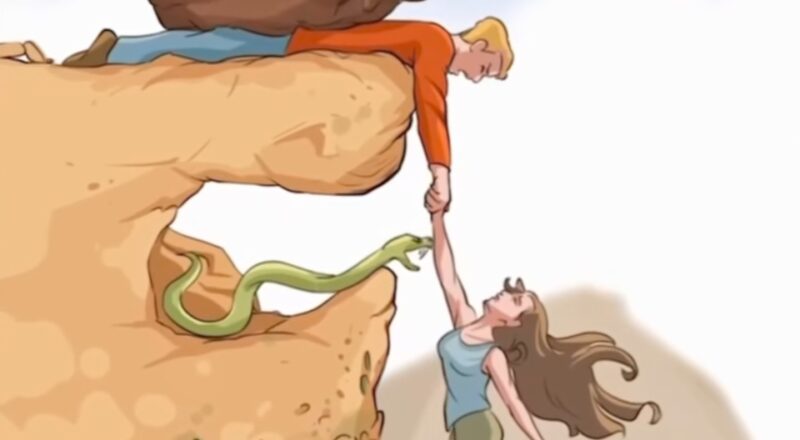
At first glance, the situation seems simple: one person is refusing to help another. But the image reveals there are two completely valid, yet conflicting, realities happening simultaneously.
The Boy’s Reality: The Crushing Weight
From the boy’s point of view,he is already performing a heroic task. He is:
· Under immense pressure: The rock on his back is a clear symbol of his own unseen burdens—this could be personal stress, financial worries, emotional baggage, or other private struggles.
· Making a supreme effort: Despite his own load, he is stretching down, holding onto the girl, and using all his strength to keep her from falling.
· Feeling misunderstood: He likely thinks, “I’m already struggling to save you. If you just put in a little more effort, you could climb up and save yourself. Why can’t you see I’m doing all I can?”
His reality is one of strain and a feeling of being unappreciated for the effort he is making.
The Girl’s Reality: The Hidden Danger
From the girl’s point of view,she is facing a terrifying and immediate threat. Her perspective includes:
· A clear and present danger: The snake represents a fear or obstacle that is obvious and paralyzing to her, but completely invisible to the boy. This could be anxiety, a past trauma, a security risk, or a personal limitation.
· A plea for help: She cannot move forward. To her, the solution is simple: “If he would just pull me up a little more, I could be safe. Why won’t he use a little more effort to save me?”
· Feeling abandoned: She feels disappointed and confused, interpreting his struggle as a lack of care or willingness to help.
Her reality is one of fear and a feeling of being unsupported in her moment of need.
The Deeper Life Lesson: Beyond Our Own Perspective
The central tragedy of this image is that both individuals are right within their own contexts, and both are suffering. The core message isn’t about who is wrong, but about the danger of assuming we have the full story. The lessons we can draw are profound:
· Everyone Has an Unseen Struggle: Just like the boy with the rock, every person you meet is dealing with a challenge you can’t see. The coworker who was short with you might be grieving. The friend who cancelled plans might be battling depression. The stranger who cut you off in traffic might be having the worst day of their life.
· Judgment is Born from Ignorance: Our frustration with others almost always stems from a lack of information. We judge their actions based on how we would behave in a vacuum, not in the complex, burdened reality they are actually in.
· Communication is the Bridge: If the boy and girl could communicate—”There’s a snake!” “I have a rock on my back!”—they could work together to find a solution. In life, a simple, compassionate question like, “Is everything okay? You seem stressed,” can open that bridge.
· Offer Understanding Before Accusation: Before you decide someone is lazy, inconsiderate, or difficult, pause. Give them the gift of assuming they have a good reason for their behavior, even if you don’t know what it is.
How to Apply This Lesson in Your Daily Life
1. Pause the Internal Judge: When you feel a negative judgment about someone arising, consciously stop yourself.
2. Consider the “Invisible Rock or Snake”: Actively ask yourself, “What unseen burden or fear might this person be dealing with that I know nothing about?”
3. Lead with Curiosity, Not Accusation: Instead of saying, “You never help me,” try asking, “You seem really overwhelmed lately. Is there anything I can do to help?”
4. Practice Empathy in Small Moments: Apply this with your family, your friends, and especially with strangers in line at the grocery store. A little grace goes a long way.
Conclusion
The cliffside struggle is a snapshot of the human condition. We are all, at various times, both the boy weighed down by our burdens and the girl paralyzed by our fears. The path to deeper, more meaningful relationships and a more compassionate world isn’t about finding people without problems; it’s about choosing to see past our own immediate perspective. It’s about putting in that extra 10% of effort not to judge, but to understand. The next time you feel disappointed or quick to blame, remember the rock and the snake. Your simple act of empathy might be the very thing that helps someone find their way to solid ground.
