The Great Lie: Why Motivation Fails and Discipline Wins
We have all been there. It is January 1st, or perhaps a random Tuesday night at 2:00 AM. Suddenly, you are struck by a lightning bolt of inspiration. You decide you are going to lose 20 pounds, write that novel, or start a side business. You buy the expensive running shoes, you download the productivity apps, and for three days, you are unstoppable.
Then, day four hits. It is raining. You are tired. That initial fire in your belly has cooled to a flicker. By day ten, the running shoes are gathering dust in the closet. What happened? You fell into the trap of relying on motivation rather than building discipline.
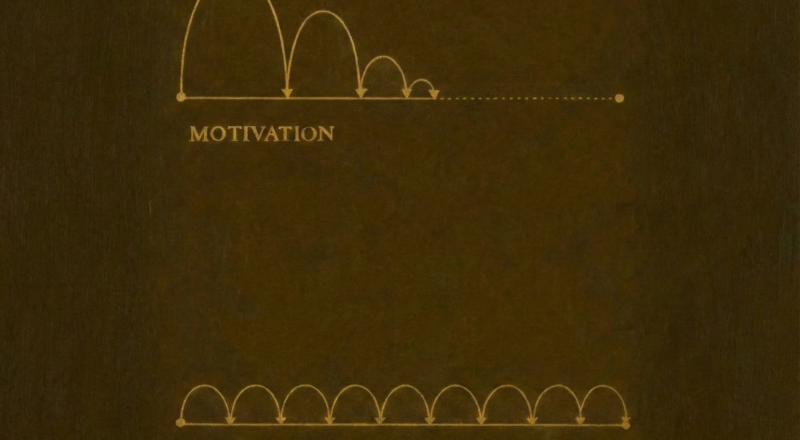
The image above perfectly illustrates the fundamental difference between these two psychological forces. Understanding this diagram is the key to unlocking long-term success in health, business, and life.
The Trap of Motivation: The Fading Bounce
Look at the top half of the diagram labeled “Motivation.” It depicts a series of bouncing arcs. The first arc is massive—it represents high energy, high excitement, and high dopamine. This is the “Honeymoon Phase” of any new goal.
The Law of Diminishing Emotions
Motivation is, biologically speaking, an emotion. Like happiness, anger, or sadness, it is fleeting. The human brain is not designed to maintain a state of high arousal permanently. If you were 100% “pumped up” 24 hours a day, you would exhaust your nervous system.
As the diagram shows, every subsequent “bounce” of motivation gets smaller. The novelty wears off. The reality of the work sets in. If you only work when you feel motivated, your effort will naturally taper off until it flatlines completely. This is the “dotted line” you see at the end of the motivation graph—the moment you quit because you “just weren’t feeling it anymore.”
Why We Love Motivation
- It feels good: Motivation provides a rush of dopamine.
- It requires no willpower: When you are motivated, working hard feels easy.
- It masks the difficulty: In the beginning, the dream seems closer than the work required to get there.
The Power of Discipline: The Steady Line
Now, shift your focus to the bottom half of the diagram labeled “Discipline.” Visually, it looks very different. There are no massive spikes. The arcs are small, uniform, and low to the ground. But most importantly, the line never fades away.
Consistency Over Intensity
Discipline is not about excitement; it is about execution. The lower height of the arcs represents the fact that discipline doesn’t require a massive emotional high. It simply requires a standard, repeatable effort. It is the ability to do what needs to be done, even if you don’t want to do it.
In the United States, we often glorify the “hustle”—the all-nighters and the extreme makeovers. But the diagram shows us that the “boring” path is actually the most effective one. Discipline is the art of showing up. It is the gym workout you do when you are tired. It is the healthy meal you eat when you want pizza. It is the report you finish when you’d rather be watching Netflix.
The Compound Effect
While the motivation line crashes to zero, the discipline line continues indefinitely. This represents the Compound Effect. Small actions, repeated consistently over time, yield results that massive, sporadic bursts of energy never can.
The Emotional Difference: A Reality Check
The transition from a “motivation mindset” to a “discipline mindset” requires a shift in how you view your own emotions.
- Motivation says: “I will do this because I feel great about it.”
- Discipline says: “I will do this regardless of how I feel.”
Think of motivation as a flaky friend who is fun at parties but disappears when you need help moving furniture. Discipline is the friend who is perhaps a bit serious, but shows up with a truck at 6:00 AM sharp because they said they would.
How to Move from Motivation to Discipline
If you look at the diagram and realize you have been living on the top line your whole life, don’t worry. You can switch tracks. Here is how to build the bottom line.
1. Stop Waiting for the “Right Mood”
Amateurs wait for inspiration; professionals just get to work. Accept that some days will be boring. Accept that some days will be hard. If you wait until you feel like working, you are leaving your success up to chance.
2. Lower the Bar (The “2-Minute Rule”)
Notice how small the arcs are in the Discipline graph? That is a secret strategy. Don’t try to run a marathon on day one. Make your daily habit so small that you cannot say no to it.
- Instead of “I will read a book a week,” try “I will read 2 pages a day.”
- Instead of “I will workout for an hour,” try “I will do 5 pushups.”
The goal is to establish the rhythm of the bottom line, not the height of the top line.
3. Build Systems, Not Goals
Motivation is goal-oriented (“I want to lose 10 lbs”). Discipline is system-oriented (“I am a person who exercises every morning”). When you focus on the identity and the routine, the results take care of themselves.
Takeaway
The image is a stark reminder of a simple truth: Intensity is overrated; consistency is undefeated.
Motivation is a spark. It is useful for getting things started, but it is fuel that burns dirty and runs out fast. Discipline is the engine that keeps running. It doesn’t need to be loud, and it doesn’t need to be high-flying. It just needs to be constant. The next time you find yourself losing steam because the excitement has worn off, look at the bottom graph. Lower your expectations for how “fun” it should be, keep your head down, and just keep moving forward.
