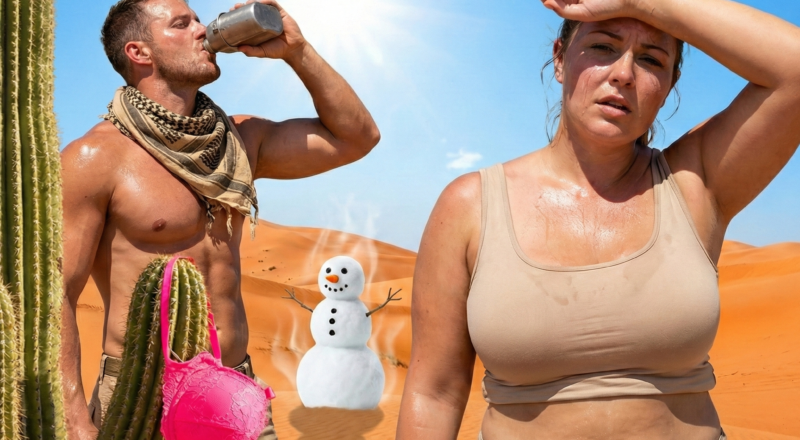
The desert is one of the most extreme environments on Earth. Defined by aridity and intense solar radiation, it is a place where the laws of **Thermodynamics** rule with an iron fist. Survival here depends on managing heat transfer and water conservation. The mistake in our puzzle—a snowman standing unmelted in the blistering sand—is a violation of the **Second Law of Thermodynamics**. Heat always flows from a hotter body to a colder one. In a 50°C (122°F) desert, a block of ice would undergo a rapid phase change, turning to water and then vapor in minutes.
This article explores the physics of heat, the reality of **Global Warming**, and the medical science of **Heat Stroke** and dehydration.
1. The Physics of Melting: Why the Snowman is Impossible
The error in the image is a contradiction of energy transfer.
Heat Transfer Mechanisms:
- Radiation: The sun blasts the desert with high-energy photons. Darker objects (like the man’s skin) absorb this heat rapidly.
- Conduction: The sand in a desert can reach temperatures of 80°C (176°F). Touching the ground transfers this heat directly to any object.
- Convection: The hot air rising from the sand (creating the “mirage” effect) surrounds objects in a superheated oven.
The Phase Change: For the snowman to survive, it would need a massive insulation barrier or an active cooling system (like a refrigerator). Without protection, the “Latent Heat of Fusion” would be overcome instantly, melting the structure.
[attachment_0](attachment)2. Climate Change and Desertification
While a snowman in the desert is a joke, the expansion of deserts is a serious global crisis.
Desertification: This is the process by which fertile land becomes desert, typically as a result of drought, deforestation, or inappropriate agriculture. It is a major threat to global food security.
Climate Migration: As equatorial regions become uninhabitable due to rising wet-bulb temperatures (heat + humidity), millions of people are becoming “Climate Refugees.” **Environmental Policy** makers are struggling to create legal frameworks to protect these displaced populations.
3. Human Physiology in Extreme Heat
The sweating couple in the image demonstrates the body’s cooling mechanism.
Thermoregulation: The human body must maintain a core temperature of roughly 37°C (98.6°F). We cool down primarily through evaporation (sweating).
Heat Stroke and Heat Exhaustion:
- Dehydration: In the desert, a person can lose up to 1-2 liters of water per hour. If this fluid is not replaced, blood volume drops, leading to organ failure.
- Heat Stroke: If the body’s cooling system fails, core temperature rises above 40°C (104°F). This is a medical emergency requiring immediate cooling. **Wilderness Medicine** training emphasizes “Cool First, Transport Second.”
4. Water Scarcity and Resource Management
The canteen held by the man represents the most valuable resource in the region.
Aquifer Depletion: Many desert cities rely on underground aquifers for water. These are “fossil water” reserves that do not replenish quickly. Over-extraction for agriculture (like growing alfalfa in the desert) is leading to a water crisis.
Desalination Technology: Coastal desert nations (like Saudi Arabia or Israel) rely on **Desalination Plants** to turn seawater into drinking water. While effective, this process is energy-intensive and produces brine waste that harms marine ecosystems.
5. Solar Energy Potential
The blinding sun is also a massive opportunity.
Concentrated Solar Power (CSP): Unlike standard solar panels, CSP uses mirrors to focus sunlight onto a central tower, melting salt to store heat. This allows the plant to generate electricity even after the sun goes down. Deserts are the ideal location for these massive renewable energy projects.
The Energy-Water Nexus: Generating energy often requires water (for cooling), and creating water (desalination) requires energy. Solving this loop is the key to sustainable desert living.
6. Adaptations of Desert Flora and Fauna
The cactus holding the decoy bra (Decoy Object) is a marvel of evolution.
Succulents: Cacti store water in their thick, fleshy stems. Their spines are actually modified leaves that reduce surface area (lowering evaporation) and provide shade for the plant itself.
Nocturnal Behavior: Most desert animals are nocturnal, sleeping in burrows during the day to avoid the lethal heat. The “Snowman” has no such adaptation!
7. The Psychology of Mirages
The heat waves in the background create optical illusions.
Refraction: A mirage occurs when light rays bend as they pass through air layers of different temperatures. The classic “water on the road” mirage is actually a reflection of the blue sky on the hot ground.
Hallucinations: Extreme dehydration can lead to delirium. Seeing a snowman in the desert might not be a physics error, but a psychological one—a hallucination of a desperate mind craving cold.
Conclusion: The Reality of Heat
The desert is beautiful but unforgiving. It respects only those who respect its power. The snowman in our puzzle is a whimsical impossibility, a reminder of the stark difference between the environments we can engineer and the environments nature dictates.
By spotting the mistake in this image, you are acknowledging the fundamental laws of nature. Ice melts, heat kills, and water is life.
Scroll back up to the image. Did you see the sweat? Did you see the snow? Don’t let the heat trick your eyes.
