Everything Will Be Okay in the End: The Art of Resilience and Hope
There is a famous quote, often attributed to John Lennon, that has carried people through some of the darkest periods of modern history: “Everything will be okay in the end. If it’s not okay, it’s not the end.”
It is a simple sentence, yet it holds a profound psychological anchor. In a world that moves at breakneck speed, where anxiety is high and uncertainty is the norm, we often mistake a “bad chapter” for a “bad life.” We see a storm and assume the weather will never change.
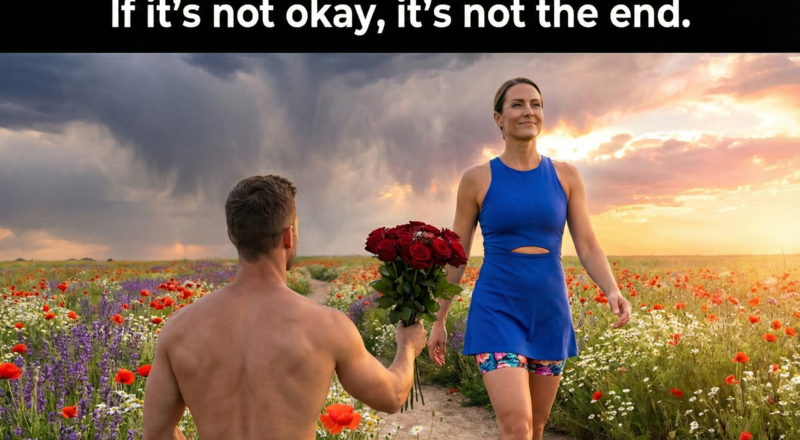
But as the image above illustrates—with its striking contrast between the fading storm clouds and the warm embrace of the sunset—life is rarely static. It is a transition. This article explores the deeper meaning behind this visual metaphor, offering practical lessons on resilience, love, and the enduring power of hope for anyone feeling stuck in the middle of their journey.
The Anatomy of Hope: Decoding the Visuals
To truly understand the message, we must look beyond the text and analyze the visual storytelling taking place. The image provides a masterclass in contrast, which mirrors the human emotional experience.
The Storm vs. The Golden Hour
- The Background: On the left, we see dark, brooding gray clouds. This represents the past—the trauma, the mistakes, and the difficulties we have just walked through. It is menacing, but notice that it is behind the subjects.
- The Foreground: The lighting shifts dramatically to the right, bathed in the soft, golden light of a setting (or perhaps rising) sun. This represents the “end” mentioned in the quote—the resolution and the peace that follows the chaos.
The Human Element
The interaction between the man and the woman adds a layer of human connection to the concept of resilience.
- The Gesture: The man is kneeling, offering red roses. In Western culture, red roses are the ultimate symbol of love and passion. However, kneeling is also a sign of humility and service. It suggests that sometimes, the thing that saves us isn’t willpower, but connection with others.
- The Expression: The woman is smiling, looking toward the light. She isn’t looking back at the storm. She embodies the mindset required to survive hard times: a forward-facing focus.
Why We Panic: The Psychology of “The End”
Why does this quote resonate so deeply? Because human beings have a cognitive bias toward catastrophizing. When we hit a roadblock—a breakup, a job loss, a health scare—our brains trigger a fight-or-flight response.
In that moment of high stress, we lose our ability to see time linearly. We feel that the pain we are experiencing now will be the pain we experience forever. We mistake the middle of the story for the finale.
This quote challenges that cognitive distortion. It forces a perspective shift. It reminds us that narratives (and lives) have arcs. If the resolution hasn’t appeared, the narrative isn’t finished.
Practical Lessons for When You Are “Not Okay”
It is easy to look at a motivational image and smile, but how do you apply this philosophy when real life hits you hard? Here are actionable steps to adopt the “It’s Not The End” mindset.
1. Adopt the “Chapter” Mentality
When you are going through hell, keep going. Churchill said it, and it applies here. View your life as a biography. You are currently writing a chapter of conflict. Every good story needs conflict to make the resolution satisfying. Without the storm in the background of the image, the sunlight wouldn’t look nearly as beautiful.
2. Look for the “Roses”
In the image, the man offers roses in the middle of a field. This symbolizes finding small moments of beauty or gratitude even when the environment is imperfect.
- Daily Gratitude: Find one small thing that went right today.
- Connection: Lean on a partner or friend. Don’t face the storm alone.
- Self-Care: Treat yourself with the same gentleness you would offer a friend.
3. Reframe Your Definition of “Okay”
Sometimes, we think “okay” means life goes back to exactly how it was before. But true resilience isn’t about bouncing back; it’s about bouncing forward. The woman in the image is walking forward, not retreating. “Okay” might look different than you expected. It might mean a new career path, a new relationship dynamic, or a newfound inner strength. Be open to a new version of “okay.”
The Role of Love and Support
The presence of the couple in the image is crucial. Often, the “end” of suffering comes through human connection. We are social creatures. When we are isolated, the storm feels louder and the night feels darker.
If you are the man in the image (the supporter):
- Show up. You don’t always need to fix the problem. Sometimes, just kneeling and offering your presence (the roses) is enough.
- Be consistent. Be the steady rock while your partner navigates the storm.
If you are the woman in the image (the one moving forward):
- Accept help. Allow yourself to receive love and support.
- Keep your eyes on the horizon. Do not let the shadows of the past dictate your future steps.
Conclusion: The Sun Always Returns
The image of the storm clearing is the oldest metaphor in human history for a reason: it is universally true. No storm lasts forever. It physically cannot. Eventually, the energy dissipates, the clouds part, and the sun returns.
If you are reading this and you feel heavy, anxious, or defeated, take a deep breath. Look at the image one more time. Focus on the light, not the clouds. Remember that your story is still being written. The pen is in your hand. And if it feels like everything is falling apart, hold on tight—because that just means you haven’t reached the end yet.
Key Takeaway
Your current situation is not your final destination. Endurance is the bridge between “not okay” and “okay.” Keep walking toward the light.
