The Paradox of Perspective: Why Your “Dream Life” Is Actually Too Small
We live in a culture obsessed with detailed planning. We create vision boards, we write five-year plans, and we manifest specific outcomes with laser-like focus. While having goals is essential, there is a profound spiritual and psychological trap in becoming too attached to our version of how things should go.
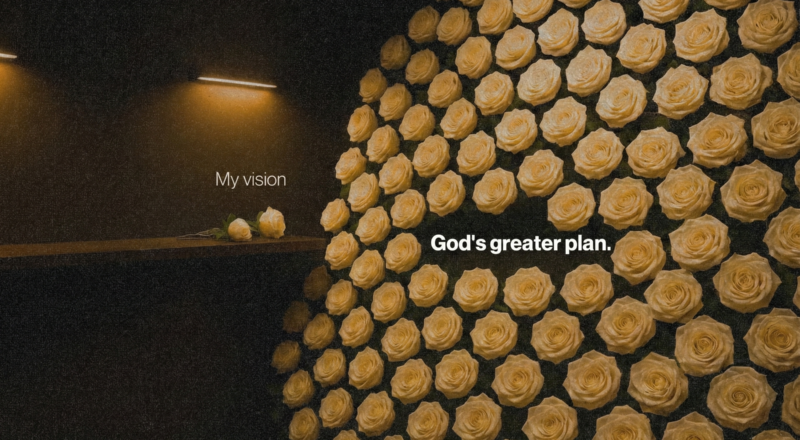
There is a viral image circulating that perfectly captures this dilemma. On one side, a small, dimly lit shelf holds two solitary roses, labeled “My Vision.” On the other side, towering over the scene, is a massive, breathtaking wall made of thousands of identical roses, labeled “God’s Greater Plan.”
This visual metaphor touches on a universal human struggle: the tension between our limited control and the infinite possibilities of the universe. Here is why we need to stop micromanaging our destiny and start trusting the abundance waiting in the wings.
The Trap of “My Vision”
Why do we settle for the two roses on the shelf? The answer lies in human psychology. We can only desire what we have seen or experienced. Our vision is limited by our past, our fears, and our immediate environment.
- The Scarcity Mindset: When we fixate on one specific outcome (e.g., “I need this specific job title”), we are operating out of scarcity. We believe there is only one path to happiness, and if we miss it, we are doomed.
- The Illusion of Control: We cling to our small plans because they feel safe. We can measure two roses. We can hold them. The mountain of roses represents the unknown, and the unknown is terrifying to the human ego.
- Misinterpreting Rejection: When we don’t get the two roses, we call it a failure. We spiral into depression, thinking we aren’t good enough. In reality, that “rejection” was simply protection from settling for less.
As the image suggests, “My Vision” isn’t necessarily bad—roses are beautiful, after all—but it is tragically small compared to what is actually available.
Understanding the Greater Plan
Whether you call it God, the Universe, Source, or Destiny, the concept of a “Greater Plan” suggests that there is a complex, benevolent orchestration of life that we cannot see from our current vantage point.
The massive wall of roses in the image represents Abundance. It represents a life where you don’t just survive; you thrive. It’s the relationship that is healthier than you knew to ask for. It’s the career path that didn’t exist five years ago but is perfect for your talents.
Why The “Greater Plan” Often Feels Like Loss
Transitioning from the left side of the image (My Vision) to the right side (God’s Plan) usually requires a painful gap period. This is the “hallway” between doors.
- The Stripping Away: To receive the abundance, you often have to let go of the two roses you are clutching. This feels like loss. It feels like heartbreak.
- The Blind Trust: You cannot see the wall of roses while you are standing at the shelf. You have to walk away from the shelf in faith.
- The Timing Gap: “My Vision” usually has a deadline of now. “God’s Plan” operates on eternal timing, ensuring you are mature enough to handle the abundance when it arrives.
Practical Lessons: How to Surrender to the Greater Plan
It is easy to look at a picture and nod in agreement, but how do you actually live this out when your heart is breaking over a lost opportunity? Here are practical ways to shift your mindset.
1. Loosen Your Grip on the “How”
Keep your goals, but change your relationship with them. Instead of praying for a specific person to love you, pray for a relationship filled with respect and connection. Instead of manifesting a specific salary, focus on a career that offers financial freedom and fulfillment. When you detach from the how, you allow the universe to deliver the result in ways better than you imagined.
2. Reframe Your Rejections
When you lose the “two roses,” realize that the shelf had to be cleared. Create a “Rejection Resume.” List every time you didn’t get what you wanted, and write down what better thing came along later because of it. You will start to see a pattern: the “No” was always leading to a better “Yes.”
3. Practice “Pronoia”
Paranoia is the belief that the world is conspiring to hurt you. Pronoia is the belief that the universe is conspiring to help you. When things go wrong, force yourself to ask: “If this were happening for my ultimate good, what would that look like?” This question shifts your brain from panic mode to opportunity mode.
The Emotional Weight of Abundance
Look at the image again. The “Greater Plan” isn’t just a bigger pile of stuff; it’s overwhelming. Sometimes, we aren’t ready for the wall of roses. If you were buried under that many flowers right now, you might suffocate.
Sometimes, the delay is character development. You are being built up so that when the blessing comes, you have the strength to carry it. The two roses are easy to hold. The wall of roses requires a strong foundation.
Conclusion: The Takeaway
If you are currently crying over a closed door, a breakup, or a missed opportunity, look at this image. Visualize your disappointment as those two small roses on the shelf. Acknowledgement that they were beautiful, and it’s okay to mourn them.
But then, lift your head. Look to the periphery. There is a reality being constructed for you that is so magnificent, so abundant, and so perfect for your soul, that one day you will look back at those two roses and laugh that you ever thought that was the end of the world.
Your vision is a snapshot. God’s plan is the whole movie. Trust the Director.
