The Psychology of Shopping: Why We Miss Details in the Aisle
The modern grocery store is a marvel of psychological engineering. From the moment you walk through the automatic doors, you are entering an environment designed to overwhelm your senses and bypass your logical decision-making. The bright lights, the vibrant colors of the produce, the smell of the bakery, and the carefully curated music are all there for one reason: to keep you shopping. In this state of sensory overload, our brains often switch to “autopilot.” We scan for familiar shapes and colors, missing the subtle details that might indicate a price change, a quality issue, or—in the case of this puzzle—a complete alteration of reality.
This “Spot the Difference” challenge invites you into the produce aisle, usually the first section of any supermarket. It’s a place of high contrast and organic shapes. But amidst the healthy greens and radiant reds, visual tricks are at play. Can you override your shopping autopilot and engage your critical observation skills? It’s harder than it looks when your brain is wired to just grab the apple and go.
The Challenge: Produce Panic
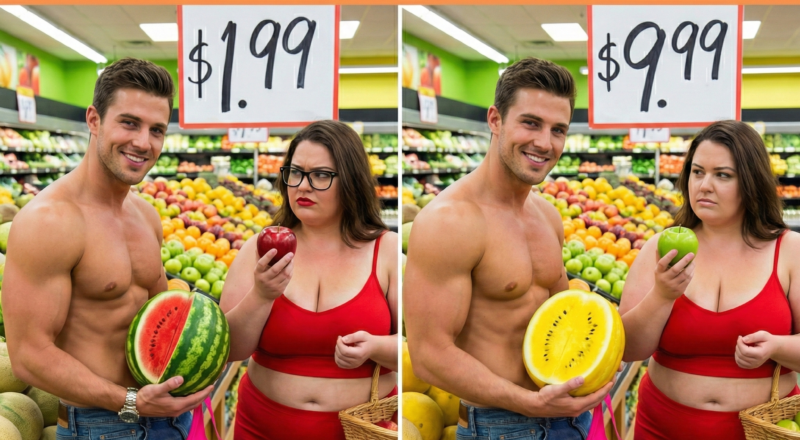
Take a look at the two images provided. They depict a vibrant scene of a couple shopping for fruit. It looks like a standard commercial or a stock photo of a healthy lifestyle. The man is showing off a melon; the woman is selecting a snack. The colors are saturated and appealing. However, five distinct elements have been swapped, changed, or removed between the two versions. Some changes affect the characters directly, altering their appearance. Others change the very nature of the items they are holding.
To solve this, you need to fight “Decision Fatigue.” This is a real psychological phenomenon where the quality of our decisions deteriorates after a long session of decision making. Grocery stores rely on this. By the time you reach the checkout, you are so tired of choosing between 50 types of cereal that you impulse-buy a candy bar. Similarly, when looking at this puzzle, your brain gets tired of comparing pixels. It wants to say “They look the same” and move on. You have to push past that fatigue and insist on verifying every detail.
The decoy object—the bright neon pink item—is placed prominently to disrupt your scan pattern. It’s a “pattern interrupt.” It doesn’t belong in a grocery store, so your brain fixates on it, trying to make sense of it. While you are staring at the decoy, you are likely missing the price tag change in the background or the accessory swap on the character. This is exactly how magicians perform sleight of hand: they give you something loud to look at while they do the work in the shadows.
Understanding “Consumer Blindness”
We often suffer from “Consumer Blindness.” We see what we expect to see. If we pick up an apple, we expect it to be red. If we see a watermelon, we expect it to be green. When the puzzle flips these expectations, our brain sometimes “auto-corrects” the image to match our mental model. You might look right at a yellow watermelon and register it as green because your brain insists, “Watermelons are green.”
Overcoming this bias requires “active looking.” You have to look at the object as a collection of colors and shapes, not as a symbol. Don’t say “He is holding a melon.” Say “He is holding a round object. What color is the rind? What color is the flesh?” This shift from symbolic thinking to literal observation is the key to spotting the differences.
This skill is incredibly useful in financial decision making and budgeting. Being able to spot the difference between a “Sale” tag that actually saves you money and one that is just a marketing trick requires the same level of detailed observation. It’s about reading the data, not just the headline.
Strategies for Visual Success
To beat the puzzle, try the “Top-Down, Left-Right” scan. Start at the very top left corner of Image A. Look at the background elements. Then look at the same spot in Image B. Move your eyes slowly to the right, like a scanner. Then drop down a few inches and scan back to the left. This systematic approach ensures you cover 100% of the image surface area.
This is a technique used in professional development for roles that require high precision, such as coding, editing, or auditing. You don’t just “read” the code; you scan it for syntax errors. You don’t just “look” at the spreadsheet; you verify the formulas. Applying this rigor to a fun puzzle strengthens the neural pathways you use for serious work.
The Solution to the Puzzle
Have you found all five? If the colorful fruit is dazzling your eyes, here is the grocery list of changes:
First, look at the Man. In the Left image, he is holding a standard Green Watermelon. In the Right image, the melon has transformed into a bright Yellow variety.
Next, check his wrist. In the Left image, he is wearing a silver Watch. In the Right image, his wrist is bare.
Now, move to the Woman. Look at her face. In the Left image, she is wearing thick black Glasses. In the Right image, she is not wearing any eyewear.
Check the fruit she is holding. In the Left image, she is inspecting a shiny Red Apple. In the Right image, the apple is a tart Green Granny Smith.
Finally, look at the background behind them. There is a price sign. In the Left image, the deal is a reasonable $1.99. In the Right image, inflation has hit hard, and the sign reads $9.99.
Why This Skill Matters
Mastering observation in a chaotic environment like a supermarket (or a puzzle of one) builds “cognitive reserve.” It keeps your brain sharp and adaptable. In your online strategy, this translates to better user experience (UX) analysis. You become the person who notices that a button color is slightly off or that a font size is inconsistent—details that affect how customers interact with a brand.
In your personal life, it helps you become a more conscious consumer. You stop being a passive participant in the “buy, buy, buy” culture and start seeing the mechanisms behind it. You notice the product placement, the lighting tricks, and the pricing games.
Plus, let’s be honest: there is a unique satisfaction in finding that last difference. It validates your focus and proves that you are in control of your own attention, rather than letting the environment dictate what you see.
What This Says About You
If you noticed the fruit color changes first, you are likely “visually dominant.” You respond to color and shape before text or small details. You are probably creative and enjoy aesthetics.
If you noticed the glasses or the watch first, you are likely “people-oriented.” You focus on faces and accessories, making you good at networking and social dynamics.
If you noticed the price tag first, you are “data-driven.” You look for numbers and facts. This makes you excellent at logistics, finance, and strategic planning.
Enjoyed this challenge?
Try
this tricky puzzle
to test your observation skills.